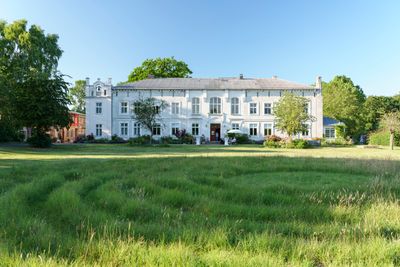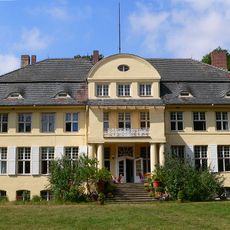
Herrenhaus Roggow, Gothic Revival manor house in Rerik, Germany.
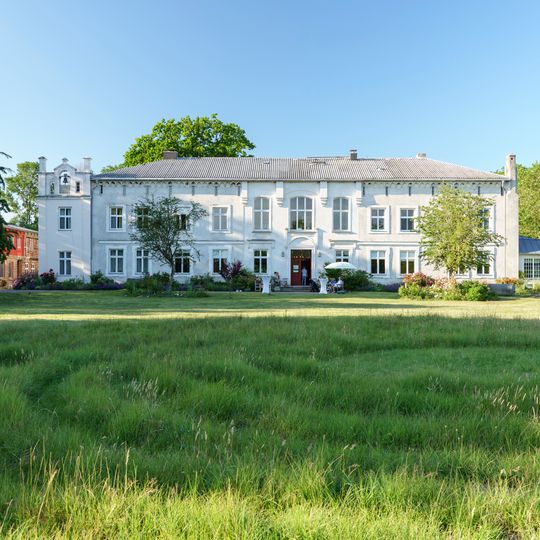
Herrenhaus Roggow is a two-storey white manor house in the village of Roggow, part of Rerik, with a grey metal roof and a symmetrical row of white-framed rectangular windows. A red double door with a small arched fanlight and white stone surround sits at the centre of the ground floor. A lower wing on the left projects forward, its gable topped by a small bell tower holding a visible bell, and decorative cresting runs along the eaves. The core is a timber-framed building of 1686, given a neo-Gothic facade by the Wismar architect Heinrich Thormann in 1850 and altered again in 1921.
Roggow was first documented in 1345, when Hermann von Oertze van Rogghowe appears as a witness in a Doberan monastery charter; the von Oertzen family is thought to have held the estate since 1192. After destruction in the Thirty Years' War, the house was rebuilt in Baroque style by 1686, with a new manor built from 1666. In 1850 the Wismar architect Heinrich Thormann added a neo-Gothic facade, and a further conversion followed in 1921.
The name Roggowe comes from Old Slavic and means horn, corner or point, referring to the estate's position at an angle of the Salzhaff. The house is a private residence with holiday flats, so visitors see the exterior and the park, not the interiors. The French Salon once held painted canvas wallpaper after Rubens prints, destroyed in 1945.
The manor stands in the middle of Roggow, about 60 metres east of the road between Rerik and Neubukow, 400 metres from the Salzhaff. It is now a private residence with holiday flats, so the house itself is not open to visitors; the facade and the grassy area in front can be seen from the village street.
The manor's interior once held a French Salon with painted canvas wallpaper, made by a French painter stranded on the nearby coast in the 18th century. He copied Rubens engravings from the Palais du Luxembourg gallery, now in the Louvre, but reversed the composition and recalled the colours from memory. The engravings were kept in the house until 1945.
The community of curious travelers
AroundUs brings together thousands of curated places, local tips, and hidden gems, enriched daily by 93,918 contributors worldwide.