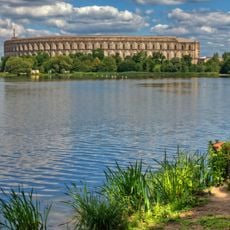
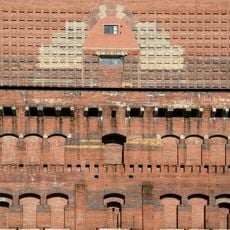
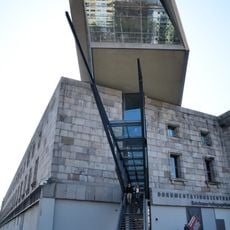
Goldener Saal, Hall in the Zeppelintribüne on the Nazi Party Rally Grounds, Nuremberg, Germany
The Goldener Saal is a hall of about 335 m² inside the Zeppelintribüne on Nuremberg's former Nazi party rally grounds, measuring 36.5 by 8.7 m plus the niches of four entrance doors and four wall niches. Its walls and floor are clad in Lahn marble slabs, and the 7.8 m ceiling carries gold-shimmering mosaics by Hermann Kaspar, which gave the room its name.
The Goldener Saal occupies the central block of the Zeppelintribüne, whose stone main tribune replaced a wooden structure and was largely finished for the 1938 rally; the hall's original purpose during the rallies is unknown. From 1985 to 2001 it housed the exhibition Faszination und Gewalt, which led to the Documentation Center. In 1986 Einstürzende Neubauten gave the only concert held there; singer Blixa Bargeld called it a reply to the site's totalitarian past.
The name comes from the 7.8-metre ceiling, covered in gold-shimmering mosaics by Hermann Kaspar. The hall's original purpose during the Nazi rallies is unknown today. From 1985 to 2001 it housed the exhibition Faszination und Gewalt, which led to the Documentation Centre. In 1986 the band Einstürzende Neubauten gave the only concert held here; singer Blixa Bargeld called it a reply to the room's totalitarian past.
Access to the hall is mainly through guided tours that explain the grounds and their architecture. Visitors should dress appropriately for a large, unheated concrete space and allow plenty of time to explore the entire complex.
The ceiling mosaics are by Hermann Kaspar, and the hall takes its name from them. One of the two fire bowls that stood on the towers blown up in 1976 is now kept inside the hall; the other sat unused behind the main tribune and served as a children's paddling pool in a Nuremberg swimming pool until 2008.
The community of curious travelers
AroundUs brings together thousands of curated places, local tips, and hidden gems, enriched daily by 92,785 contributors worldwide.