Schilling Bridge, Stone bridge in Friedrichshain-Kreuzberg district, Germany.
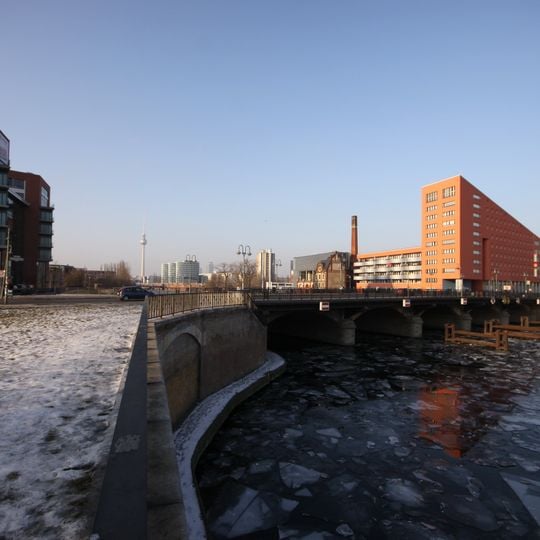
Schilling Bridge is a stone bridge spanning the Spree River, connecting the neighborhoods of Kreuzberg and Friedrichshain. The structure stretches across approximately 75 meters and accommodates vehicles, cyclists, and pedestrians.
Johann Friedrich Schilling, a master mason and city deputy, founded a private bridge-building company in 1839 and had a wooden bascule bridge erected here, financed by a toll and named after him. The city took over the bridge in 1862 and abolished the fee. The present structure was built between 1870 and 1874 under city building inspector Leopold Seeck: 75 metres long, 15 metres wide, of brick masonry clad in Silesian sandstone.
The bridge functions as a daily crossing for residents moving between Kreuzberg and Friedrichshain, embedding itself into the fabric of how people navigate the city. Its stone structure has become part of the local identity of both neighborhoods.
The bridge is open to all types of traffic and provides reliable passage at any time of day. The stone surfaces can become slippery when wet, so extra care is needed during or after rain.
The allegorical reliefs carved in Emil Hundrieser's workshop on the piers and parapets have been hidden since 1912, when 4.10-metre steel cantilevers were added on both sides for new footpaths and utility lines. Cleaned and conserved in the 1991–1994 restoration, they remain barely visible to anyone crossing.
The community of curious travelers
AroundUs brings together thousands of curated places, local tips, and hidden gems, enriched daily by 94,515 contributors worldwide.