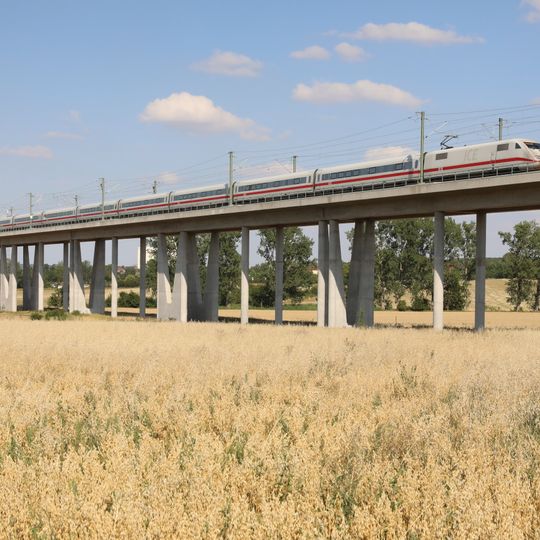
Gänsebachtalbrücke, Railway bridge in Buttstädt, Germany
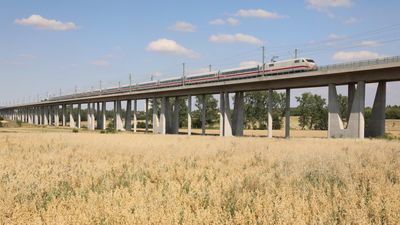
The Gänsebachtalbrücke is a railway bridge made of prestressed concrete near Buttstädt that spans across the valley. The structure consists of ten independent segments with slender round supports and reinforcing plates that shape its appearance.
Construction began in January 2009 and was scheduled for completion in December 2011; the last 55 m section was concreted on 16 August 2011. The executed design replaced the 1995 tender plan for a 1012 m hollow-box bridge with a 1001 m two-web plate-beam structure, revised after a proposal by the construction company following review by a Deutsche Bahn expert committee in 2008. The bridge was built by Adam Hörnig Baugesellschaft using a launching girder, with bored piles 1.2 m in diameter and 10 to 18 m long.
The bridge won the undivided German Bridge Construction Prize in 2014 in the road and railway bridges category. The jury cited its very light construction, which fits into the surroundings and leaves the view of and from the nearby village open, and its aesthetic rhythm of supports. It also praised the consistent separation of transverse and longitudinal stiffness as a pioneering design idea.
The bridge is visible from the nearby village of Buttstädt and is suitable for anyone wanting to photograph modern infrastructure. The best viewing opportunity comes from the surrounding roads and paths that offer sight lines to the structure.
The design eliminates expensive technical elements such as bearings and rail expansion joints by dividing the construction into ten independent blocks. This practical approach reduces maintenance work and extends the lifespan of the entire installation.
The community of curious travelers
AroundUs brings together thousands of curated places, local tips, and hidden gems, enriched daily by 92,644 contributors worldwide.