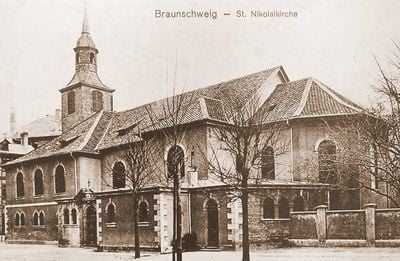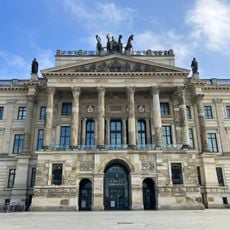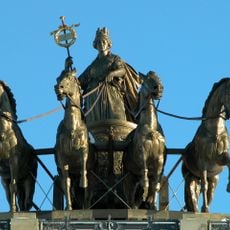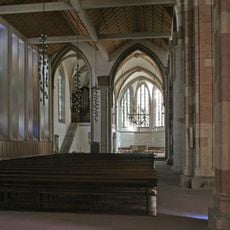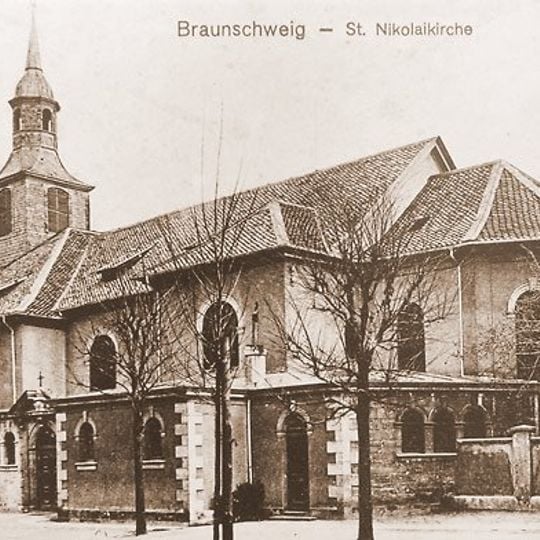
St. Nicolai in Braunschweig, Baroque timber-framed church in Braunschweig, Germany.
St. Nicolai was a south-facing timber-framed church built by Hermann Korb and Count Damian Hugo von Schönborn between 1710 and 1712 on Friesenstraße. Its entrance had Ionic pilasters and a niche figure of St. Nicholas between sculptures of Faith and Hope; the two-storey north end housed the clergy. Inside, a wooden-panelled mirror vault with frescoes of the Trinity and biblical scenes rested on free-standing pilasters.
Duke Anton Ulrich commissioned the church in 1710 as the first Catholic sanctuary built in the city after it turned Lutheran in the 16th century. It stood until 1944, when it was destroyed during World War II.
The church served as a Catholic gathering place in a predominantly Lutheran city, where members of the faith practiced their religion together. Religious artifacts and decorative elements gave worshippers a sense of spiritual identity and belonging within the community.
The church no longer exists: its site on Friesenstraße is now the schoolyard of the Edith Stein Catholic primary school. The surviving outer frame of the portal was moved in 1968 to a wall by a car park between Echternstraße and Güldenstraße, removed in 2011, and now forms the schoolyard gate on Friesenstraße. Other facade elements were proposed for the Westpark and are not on public view; a portal figure is kept in the Aegidienkirche.
Inside the church, four Roman columns supported angel statues in an unusual artistic arrangement. Wooden figures of Apostles Peter and Paul stood between these columns, creating a distinct religious grouping that set the interior apart.
The community of curious travelers
AroundUs brings together thousands of curated places, local tips, and hidden gems, enriched daily by 92,633 contributors worldwide.