Gut Deesberg, Manor house in Bad Oeynhausen, Germany.
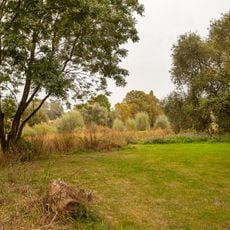
Gut Deesberg is a manor house in the Rehme district of Bad Oeynhausen, west of the Weser and south of the Wiehen and Weser hills. The estate is a working organic farm; former brickworks and mushroom-growing buildings now house small businesses, and the fields carry clover grass, grain, rapeseed, potatoes and short-rotation coppice on the old clay pits.
Records of Gut Deesberg begin in the 16th century; in 1567 Droste Bertram von Landsberg moved his residence from Vlotho Castle to the estate. In 1655 Freiherr von der Horst acquired it, and in 1709 the castle was sold for demolition while the prison and barn stayed with the estate. From 1739 it was a state domain, the prison was abolished in 1858, and Burg Vlotho belonged to the estate until 1889.
The name Deesberg is tied to the estate's long role as an agricultural and industrial site rather than to noble display. Since 1914 it has belonged to the Rolfsmeyer family, and from 1980 the farm switched to organic cultivation. Today clover grass, cereals, rapeseed and potatoes grow on the fields, and fast-growing trees are harvested every three to four years on the former clay pits as fuel.
The estate is private property and not open to the public, so the grounds and buildings cannot be visited. Its organic beef and other farm products are sold directly from the farm; ask on site or by phone about current availability before making the trip.
The brickworks was founded in the late 18th century by the tenant Haccius, who fired bricks mainly for the estate's own building work. His successor Carl Hentzen turned it into a commercial business, and in 1909 the owner Major Blecken von Schmeling applied for a new ring kiln. Brickmaking ended in 1962.
The community of curious travelers
AroundUs brings together thousands of curated places, local tips, and hidden gems, enriched daily by 92,702 contributors worldwide.