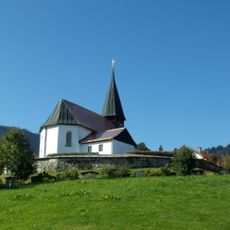
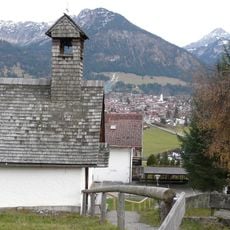
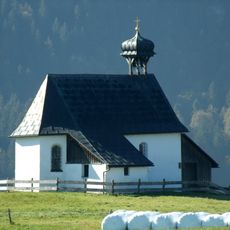
Judenkirche, Natural arch in Oberstdorf, Germany.
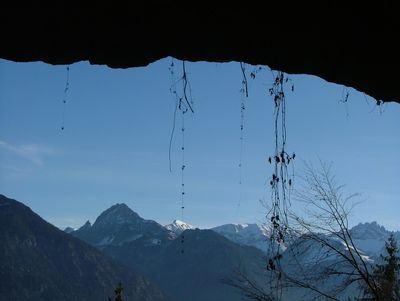
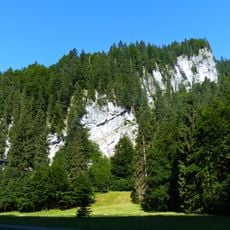
Judenkirche is a limestone arch formation located near Oberstdorf, measuring about 15 meters long and 2 meters wide at an elevation of around 1060 meters. The formation combines arch-like features with a substantial cavity extending behind it, creating a geological structure that functions as both arch and partial cave.
The name Judenkirche has no documented origin. Barbara Rösch links 19th-century toponyms containing 'Jude' to the attitudes of non-Jewish name-givers, often with a defamatory character; the arch's resemblance to a temple arch, once popularly equated with a 'Judenkirche', may explain the name. Paul Schwendinger instead suggests the rock was originally called 'In der Kirche' and that the current name arose from an inaccurate transcription. The arch has been a protected geotope since June 2007.
The name's origin is uncertain. Barbara Rösch links it to 19th-century toponyms containing "Jude", which she says reflected the mentality of non-Jewish name-givers and often had a defamatory character; the arch resembles a temple arch, once popularly equated with a "Judenkirche". Paul Schwendinger instead suggests the folk name was originally "In der Kirche", altered through imprecise transcription.
The arch stands at 1060 m on the slope of the Ochsenberg near the Breitachklamm. It is one to two metres wide and closed to walking through. Trees in front of the arch were felled in 2008 to open the view.
This formation only received official protection as a natural monument in 2007, despite being known for centuries. This relatively recent recognition shows how geological features can remain overlooked for long periods before their scientific value is formally acknowledged.
The community of curious travelers
AroundUs brings together thousands of curated places, local tips, and hidden gems, enriched daily by 92,745 contributors worldwide.