Harburg castle, Medieval château in Harburg, Hamburg, Germany.
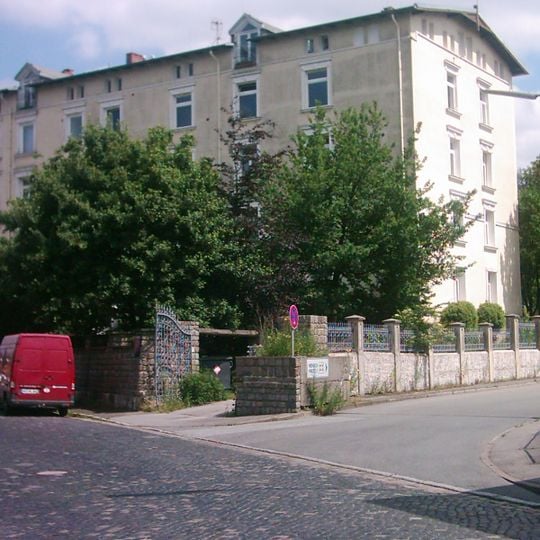
Harburg Castle stands on the Schlossinsel in Hamburg's Harburg inland harbour. Of the former complex, only a heavily altered side wing survives, with 14th-century cellar vaults and parts of the outer walls. The building is pale beige with rows of white-framed windows and a dark, slightly sloped roof; a low stone wall with a blue scrollwork gate runs along the street.
First documented between 1133 and 1137 as Horeburg, the castle was probably built by the Counts of Stade on a sand island in marshy ground by the Süderelbe. In 1257 it passed to the Welf dukes, and from 1527 to 1642 it served as the residence of a junior Brunswick-Lüneburg line, who rebuilt it as a Renaissance palace with three wings from 1620/21. In 1644 it became a Baroque fortress with a five-pointed star plan, for which the Kaufhaus, the Waage and the Marienkirche were demolished. French troops besieged it in 1757, and a fire damaged it in 1813.
The name Horeburg, first recorded between 1133 and 1137, means "castle in the marsh", referring to the sand island in the marshy Süderelbe where the counts of Stade built it. The settlement of burghers, craftsmen and suppliers that grew on the dam to the geest became the town of Harburg. The surviving wing was converted into workers' housing in 1900, and a permanent exhibition on the town's origins is planned in the cellar vaults as an outpost of the Archäologisches Museum Hamburg, opening in 2027.
The castle stands on the Schlossinsel in the Harburg inland harbour; the surviving wing is reached from the surrounding streets, and the pentagonal outline of the 17th-century citadel can still be traced along the quay edges of the island. Renovation is under way, and a permanent exhibition on Harburg's origins is planned for the cellar vaults as an outpost of the Archaeological Museum Hamburg, scheduled to open in 2027.
The building visible today gives no hint of a castle: it is a side wing converted into workers' housing in 1900, after the site passed to Reinhold F. Holtz and his Schlosswerft shipyard in 1898. The east wing was demolished in 1972; the remainder was re-listed as a monument in 1988, after protection granted in 1944 was lifted in 1950.
The community of curious travelers
AroundUs brings together thousands of curated places, local tips, and hidden gems, enriched daily by 92,642 contributors worldwide.