Heilig Blut, Church building in Munich, Germany.
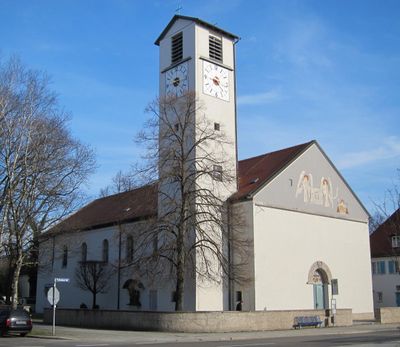
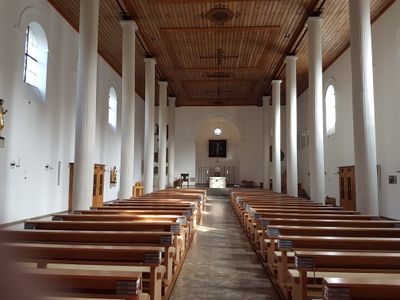
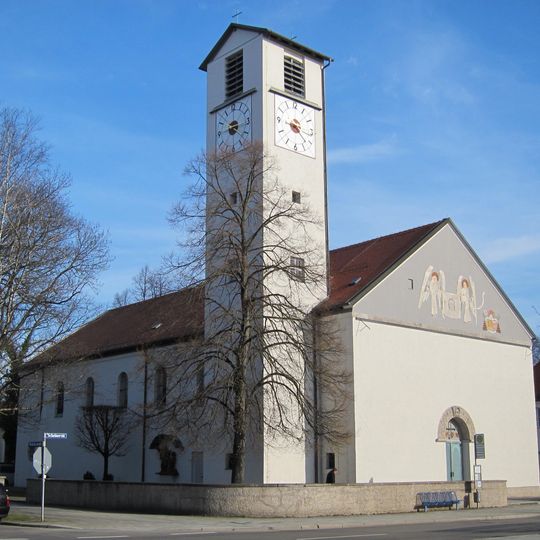
Heilig Blut is a Catholic parish church in Munich's Bogenhausen district, built in 1934 to Hans Döllgast's plans as a hall church 40 m long, 16 m wide and 9 m high. Its white walls carry a steep red-tiled roof, a square clock tower with a cross, and a faded mural above the arched blue entrance door. Inside, 14 smooth white columns line the walls beneath a flat dark wood ceiling, with light wooden pews facing the raised sanctuary.
Heilig Blut was built in 1934 in eight months to plans by Hans Döllgast, after residents protested against converting the old St. Georg church and the city donated the site. Cardinal Faulhaber consecrated it on 1 November 1934. Bombing on the night of 2–3 October 1943 destroyed it except for the walls; Döllgast rebuilt it in 1950, raising the bell chamber ten metres and giving the tower a gabled roof.
The name Heilig Blut refers to the Holy Blood. Since 2009 the entrance portal has been a glass-and-bronze work titled "Deus Caritas Est", dedicated to Pope Benedict XVI, who served as chaplain here from August 1951 to September 1952. A memorial plaque at St. Georg church recalls chaplains Alfred Delp and Hermann Josef Wehrle, arrested in 1944.
The church is accessible by Munich's public transportation network and offers parking options for those arriving by car. It is good to check visiting hours beforehand, especially if you plan to enter the building rather than view it from outside.
The tower's belfry was raised ten metres during Hans Döllgast's 1950 rebuild, so the bells now sit above the church's gable line, and the spire was replaced by a saddle roof. The 1934 relief arch over the entrance is by Georg Pezold, who had campaigned against rebuilding St. Georg.
The community of curious travelers
AroundUs brings together thousands of curated places, local tips, and hidden gems, enriched daily by 94,120 contributors worldwide.