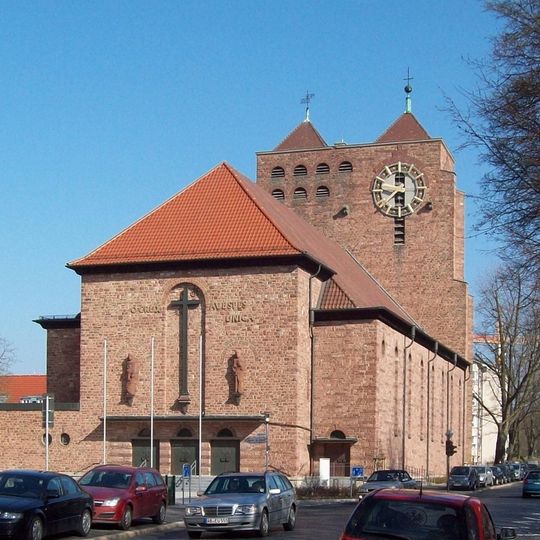
Herz-Jesu-Kirche, Catholic church in Aschaffenburg, Germany.
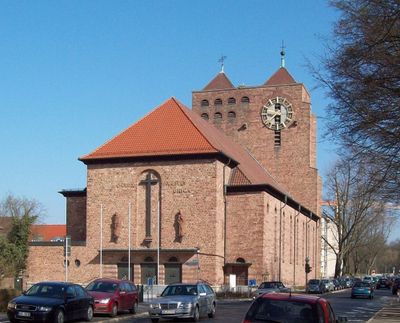
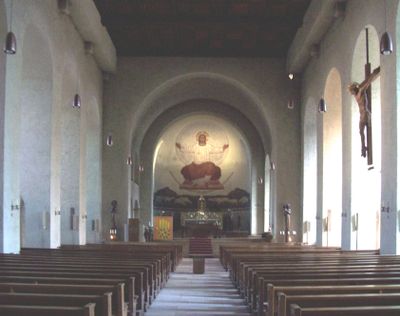
The Herz-Jesu-Kirche is a red-brick Catholic church built in 1928/1929 in Aschaffenburg, designed by Albert Boßlet in the style of a fortified church with twin towers. Its gabled facade carries a stone cross inscribed "CHRISTUS" and "UNUS" above three round-arched doorways; the square tower has a clock with gold Roman numerals. Inside, a long nave with dark wooden pews and a rounded apse holding a large wall painting of Christ with outstretched arms.
Construction of the church took place between 1928 and 1929 in Aschaffenburg and faced severe damage in the early 1940s. A bombing raid in 1944 destroyed the western wall and collapsed the nave ceiling significantly.
The name refers to the Sacred Heart of Jesus, to whom the church is dedicated. The interior includes a marble altar with a gilded round tabernacle and a depiction of Christ as the Good Shepherd in the choir. The 1995 Vleugels organ, with 63 registers, has been used for numerous concerts beyond liturgical services.
The church stands south of the Aschaffenburg–Würzburg railway line in the Österreicher Kolonie district. Its interior is a single long nave with wooden pews on both sides of a pale stone floor, so seating is ample during services. The 1995 Vleugels organ, with 63 stops on four manuals and pedal, is used for concerts as well as liturgy.
The sound arches of the tower follow the design of those in St. Kamillus monastery church in Mönchengladbach, built 1929–1931 by Dominikus Böhm. The 1956 Otto foundry replaced the surviving Petrus-Canisius bell, tuned to F-sharp, with five new bronze bells; a 1955 plan by the Schilling foundry to fill the whole belfry failed for lack of money.
The community of curious travelers
AroundUs brings together thousands of curated places, local tips, and hidden gems, enriched daily by 94,370 contributors worldwide.