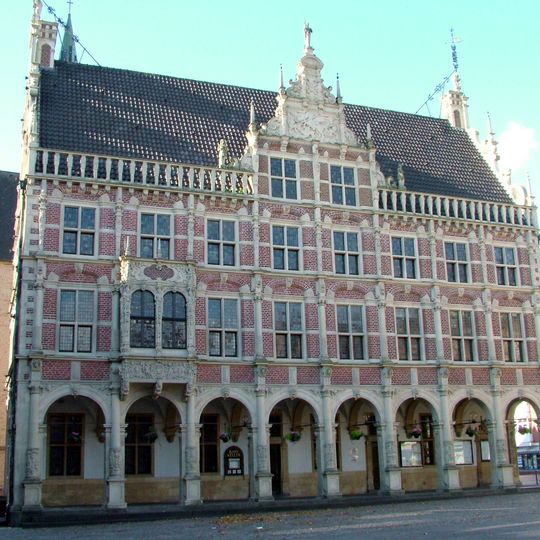
Altes Rathaus, Renaissance town hall at Market Square, Bocholt, Germany
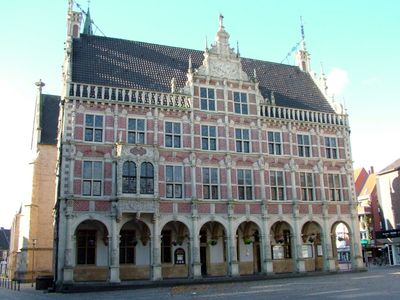
The Altes Rathaus is a Renaissance administrative building on Market Square in Bocholt featuring Dutch brick construction with a symmetrical facade. The structure contains eight vertical axes and three floors, with the ground level originally forming a covered arcade.
Construction took place between 1618 and 1621, creating a Dutch Renaissance structure for the growing city. The building suffered severe damage during World War II but underwent complete reconstruction from 1948 to 1955.
The central gable shows Saint George, the city patron, and the balustrade rests on consoles carved with animal and human faces. The upper-floor oriel displays Bocholt's coat of arms, a beech tree between two knights, with the bar of the Münster cathedral chapter above it. Its windows show the four civic virtues—Prudence, Justice, Temperance, and Fortitude—made by Otto Linnemann of Frankfurt in 1910.
The registry office (Standesamt) is on the first floor, not the ground floor, and weddings take place there; the building itself has mainly represented the city since the administration moved out in 1977. The Rathaus stands across the rectangular market square, so its long eaves side, not the gable end, faces the square. The cellar and parts of the ground floor house a restaurant.
The ground floor originally contained a covered arcade connecting the courthouse, city weighing room, meat hall, and guard quarters all in one space. This arrangement allowed citizens to access multiple services from a single location.
The community of curious travelers
AroundUs brings together thousands of curated places, local tips, and hidden gems, enriched daily by 93,595 contributors worldwide.