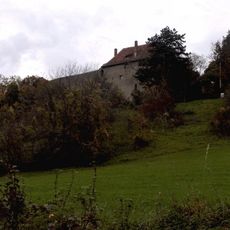
Homburg, Medieval castle ruin in Stahringen, Germany
Homburg is the ruin of a high-medieval hilltop castle on a spur above Stahringen, at 635.3 m. Its surviving features are a ring wall and a shield wall faced with large Nagelfluh bossed ashlars up to almost 3 m thick, plus a stretch of wall over 11 m high. No coherent reconstruction exists; an 18th-century painting shows a round tower.
The Homburg's origins trace to the 11th century, when the Lords of Homburg, former ministeriales of the Bishop of Konstanz, built the ring-wall on Ice Age gravel above Stahringen. In 1499 Swiss War troops plundered and burned it; it was rebuilt and enlarged in 1502. Wolf von Homburg sold the lordship to his son-in-law Hans Konrad von Bodman in 1565, and in 1614 it passed to the Benedictine monastery of St. Gallen. Konrad Widerholt burned it in 1642; afterwards it served as a quarry.
The name Homburg comes from the Lords of Homburg, ministeriales of the Bishop of Konstanz, who built the castle in the 11th century. Wolf von Homburg sold the lordship to his son-in-law Hans Konrad von Bodman in 1565; Wolf died a year later in Radolfzell, where a bronze epitaph in the Münster still commemorates him. After the Thirty Years' War the ruin served as a quarry, and its stones are found in the farms below.
The ruins are accessible year-round via marked hiking trails starting from Stahringen and can be explored independently at your own pace. Wear good hiking shoes and bring weather-appropriate clothing since the terrain is uneven and paths can become slippery in wet conditions.
From the elevated location you can see across the surrounding fields and forests, which clearly shows why this spot was strategically important in the past. This view across the landscape is one reason visitors today find the hike to these ruins rewarding.
The community of curious travelers
AroundUs brings together thousands of curated places, local tips, and hidden gems, enriched daily by 94,632 contributors worldwide.