St. Severin, Keitum, Lutheran church in Keitum, Germany.
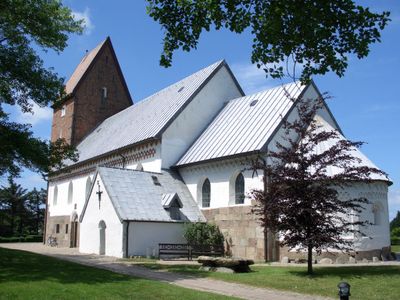
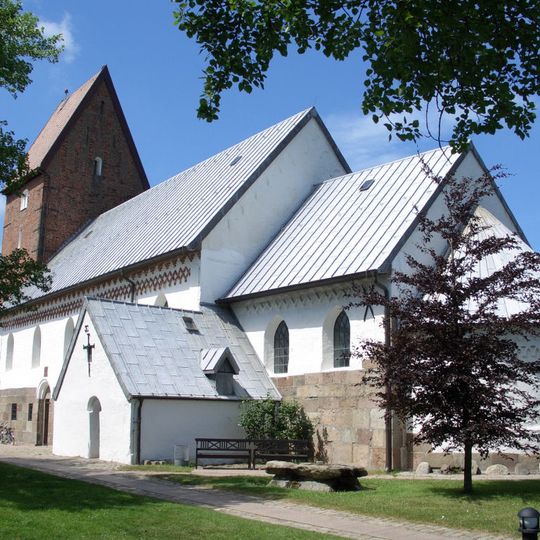
St. Severin is a Romanesque church with a nave, narrower chancel and semicircular apse built of granite blocks, white-plastered tuff and brick, topped by lead roofs. Its square tower of dark red brick, added around 1450, is the only Gothic brick structure on Sylt. The south side has a small lead-roofed porch called Karfaster, and the nave windows are pointed.
The nave, chancel and apse date to 1216, when dendrochronology of the roof rafters confirmed the church as the oldest in Schleswig-Holstein. It was first documented in 1240 and probably first dedicated to St Canute. After the plague of 1350 and the Grote Mandrenke storm of 1362 depopulated Sylt, missionaries from the Archdiocese of Cologne rededicated it to St Severin. The brick tower followed around 1450, and the church became Lutheran in 1544.
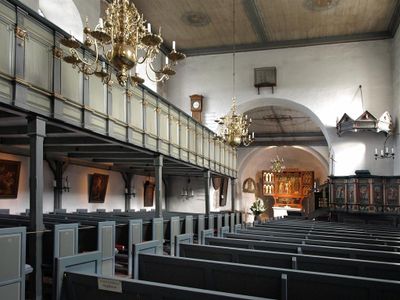
The church is dedicated to Severin of Cologne, whose name replaced an earlier dedication to St Canute after missionaries from the Cologne archdiocese revived worship on the island. The brass chandeliers were donated by sea captains in 1683, 1698 and 1700, and the Renaissance pulpit of 1580, carved with the virtues Faith, Temperance and Justice, was given by the pastor couple Gruppius in 1699.
The main entrance is now on the north side, as the former 15th-century south porch serves as the vestry. The tower room, bricked up after a 1740 accident, reopened in 1981 as an extension to the nave and entry hall. The church stands on the highest point of Sylt's geest core, set apart from Keitum.
The church tower once served a dual purpose: as a navigation aid for seafarers and as a prison. A chamber inside the tower remained sealed from 1740 until 1981, revealing how this structure played multiple roles in the island's history.
The community of curious travelers
AroundUs brings together thousands of curated places, local tips, and hidden gems, enriched daily by 94,264 contributors worldwide.