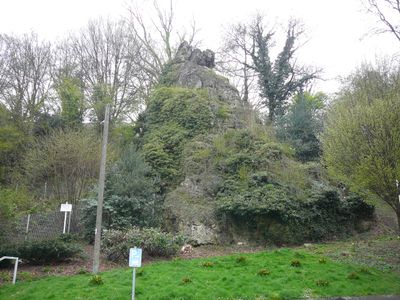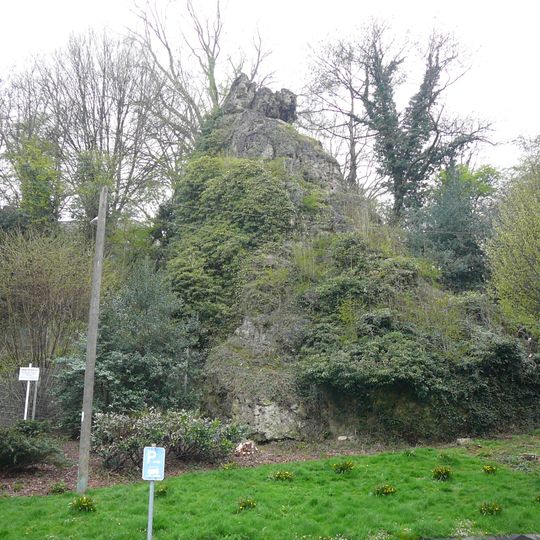
Hohenstein, Natural monument and rock formation in Wuppertal, Germany.
Hohenstein is a dolomite cliff formation in a park near Wuppertal that rises from the surrounding wooded landscape. The rock displays exposed geological layers that visitors can view from different angles throughout the site.
The formation dates back about 390 million years to the Middle Devonian period when it was part of an ancient coral reef. These marine deposits were later incorporated into the limestone structures of the region.
A 19th-century description links the rock to a Germanic cult site dedicated to the earth goddess Hertha, said to have served as an altar. A black stain on the stone gave rise to the name Teufelskanzel, the Devil's Pulpit; another interpretation sees the rocks as a petrified bridal couple.
Two footpaths lead to this formation and make it easy to access on foot. Informational signs help visitors understand the geological features and history of the place.
The rock's other name, Teufelskanzel (Devil's Pulpit), comes from a black patch on the stone, which was read through the medieval theory of the inkwell. A separate interpretation holds that the rocks represent a petrified bridal couple.
The community of curious travelers
AroundUs brings together thousands of curated places, local tips, and hidden gems, enriched daily by 93,898 contributors worldwide.