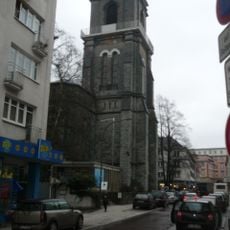
Opernhaus Wuppertal, Opera house in Wuppertal, Germany
The Opernhaus Wuppertal is a theatre building in the centre of Wuppertal-Barmen, originally designed by Carl Moritz as the Stadttheater Barmen. Its exterior mixes neo-Baroque and Jugendstil elements, while the interior, rebuilt after 1943, reflects 1950s aesthetics with two tiers instead of the original four. The complex was extended in the 1970s and fully renovated from 2006 to 2009.
The building was constructed in 1905 and shaped the city's cultural life with opera and theater performances ever since. During World War II it suffered severe bomb damage but was carefully rebuilt in the 1950s and reopened for audiences afterward.
Since 1974 the house has also been the stage of Pina Bausch's Tanztheater Wuppertal, alongside the Schauspielhaus in Elberfeld. Its pieces include Frühlingsopfer (1975), danced on a stage covered with soil, Café Müller (1978) and Kontakthof (1978), performed by an ensemble aged between 58 and 77. The theatre is also known for reviving operas outside the standard repertoire.
The venue is centrally located in Wuppertal and is easily accessible by public transportation. Visitors should check the current program before their visit, as offered productions vary depending on the season and availability.
The suspension railway stop next to the house is called Adlerbrücke, a name taken from the building but used only as a local suffix and not consistently in timetables. The 2021 floods submerged the entire lower stage, orchestra pit, stage machinery, electrics and ventilation 1.5 metres deep; damage was estimated at 6 to 10 million euros.
The community of curious travelers
AroundUs brings together thousands of curated places, local tips, and hidden gems, enriched daily by 92,843 contributors worldwide.