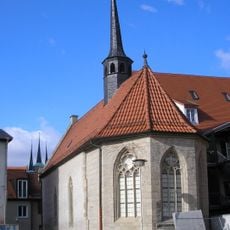
Hirschgarten, Public park in Erfurt, Germany.
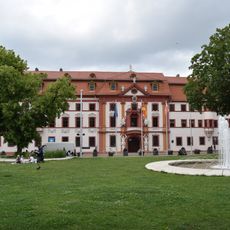
Hirschgarten is a 0.6-hectare green space in Erfurt's old town, bounded by Regierungsstraße, Neuwerkstraße and Eichenstraße. It consists of the historic 18th-century garden and a western section redesigned from 2007 to 2009 on a cleared site. The grounds lie opposite the Thuringian State Chancellery.
In 1732 the Mainz governor Anselm Franz Ernst von Warsberg had two rows of houses demolished to create an enclosed open space, planted with trees between 1734 and 1740 and stocked with red deer for over 40 years, which gave the site its name. From 1780, under Karl Theodor von Dalberg, it became Erfurt's first green space opened to the public. In 1798 it was redesigned as a botanical garden for plants of the Erfurt region, with a stone Temple of Flora honouring botanists Johann Hieronymus Kniphof and Christian Reichart.
The name comes from the red deer kept here from 1734 to 1740. In 1798 it became a botanical garden holding only plants from the Erfurt area, and a small stone Temple of Flora was built with portraits of botanists Johann Hieronymus Kniphof and Christian Reichart. In 1803 busts of King Frederick William III and Queen Luise were placed in it.
The Hirschgarten lies in the triangle formed by Regierungsstraße to the north, Neuwerkstraße to the south and Eichenstraße to the west, opposite the Thuringian State Chancellery. The historic eastern section and the western part redesigned in 2007–2009 are linked; the whole area covers about 0.6 hectares.
The western section was rebuilt on the cleared site of the never-finished "Haus der Kultur", a GDR cultural centre whose concrete-and-steel shell Erfurters nicknamed the "ship lift". Its shell was demolished from July 1996. The 2009 redesign by the Berlin office Loidl won the Thüringer Landschaftsarchitekturpreis.
The community of curious travelers
AroundUs brings together thousands of curated places, local tips, and hidden gems, enriched daily by 94,443 contributors worldwide.