St. Andreas, Lutheran church in Schlutup, Germany
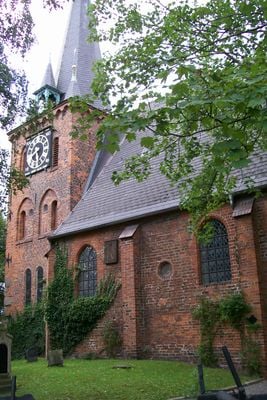
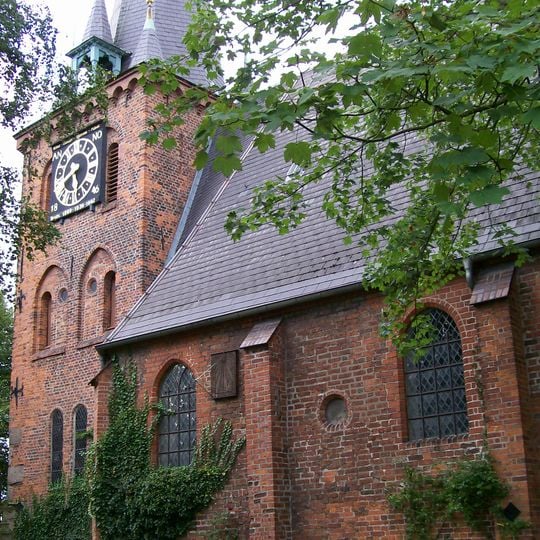
St. Andreas is an Evangelical Lutheran hall church of brick Gothic in Schlutup, its octagonal nave 22 metres long, 12.30 metres wide at the west end and narrowing to 11.30 metres at the east, said to recall a Hanseatic cog. A square brick tower with a clock and a green copper lantern was added in the late 16th century. Tall pointed-arch windows with dark lattice glazing light the long body under a steep grey slate roof, and ivy climbs the left corner.
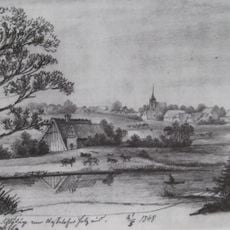
A chapel in Vretup, then part of St. Jakobi's parish in Lübeck, was documented in 1425; Schlutup became its own parish in 1436, when construction of St. Andreas began. The square west tower was added in the late 16th century and appears in a view of Schlutup from 1601. In 1711 captured Swedish soldiers were held in the church, and in 1806 Napoleonic troops imprisoned Prussian soldiers there and vandalised the interior.
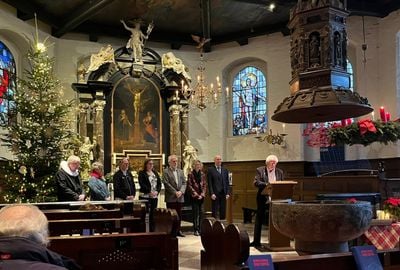
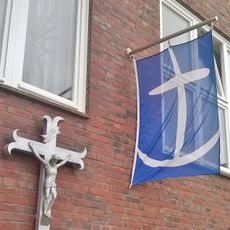
The church is dedicated to the Apostle Andrew, patron saint of fishermen, and served as a meeting room for Schlutup's fishermen in the mid-18th century. The 1928 stained-glass window showing Andrew was donated by fish industrialist Gustav Herbst, and the 1936 window of Peter's catch by Albert Holst.
The church stands in Schlutup, a district at Lübeck's eastern edge on the Trave. The tower with its clock and green copper lantern marks the entrance; the main body extends to the right under a slate roof. Ivy grows on the left corner and between the windows. The interior is entered from the west tower side.
The two largest bells, cast by Matthias Benningk in 1590 and 1597, have almost exactly the same pitch. The smallest was cast in 1772 by Johann David Kriesche in the yard of Lübeck's council foundry. A fourth, historic confessional bell hangs on the outer spire.
The community of curious travelers
AroundUs brings together thousands of curated places, local tips, and hidden gems, enriched daily by 94,156 contributors worldwide.