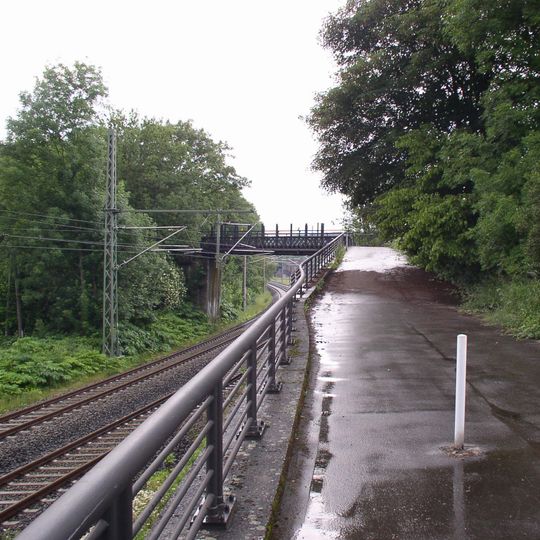
Hundebrücke, Heritage bridge in Essen, Germany
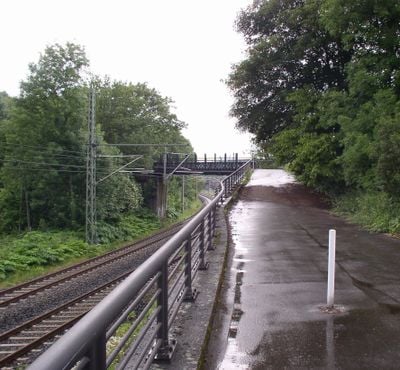
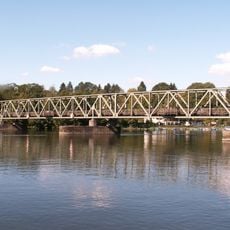
The Hundebrücke combines a stone arch section spanning the Deilbach stream with a steel lattice framework that crosses railway tracks below. The two distinct structural sections work together to create a continuous path for pedestrians and cyclists.
The structure was built in 1880 to move stones from a nearby quarry toward a railway station. The small wagons that traveled this route would later inspire the bridge's distinctive name.
The bridge takes its name from the small rail wagons called Hunde that once carried stones across these spans. Today it stands as a reminder of the region's industrial past and attracts visitors interested in the Ruhr area's working heritage.
The bridge connects the neighborhoods of Byfang and Kupferdreh and is easily accessible on foot or by bicycle. Both structural sections are safe to cross without requiring any special equipment or precautions.
The steel lattice design follows a construction principle patented by Ithiel Town and represents an early application of this method in Germany. This bridge shows how engineers began transitioning from traditional stone to steel for spanning longer distances.
The community of curious travelers
AroundUs brings together thousands of curated places, local tips, and hidden gems, enriched daily by 91,372 contributors worldwide.