Stiftsmuseum der Stadt Aschaffenburg, Museum of prehistory and art in Aschaffenburg, Germany
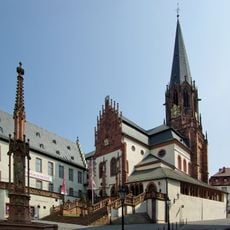
Stiftsmuseum der Stadt Aschaffenburg occupies the former chapter house of the collegiate foundation of St. Peter and Alexander, a complex of late medieval buildings around a Romanesque cloister built between 1220 and 1275. The west wing rests on a basement from the second half of the 10th century and was raised in 1480 with a stepped gable and a terrace with a stone pulpit. Inside, the chapter hall, the Gothic Hall and the Paramentenraum with a stucco ceiling of 1723 survive.
The collegiate chapter of St. Peter and Alexander is first documented in 957. Its chapter house served as archive and library from 1804, as the princely archive from 1808, as a drawing school from 1839 and as a district court from 1848. The city museum, founded in 1854, has occupied the building since 1861; after World War II damage, restoration ran from 1985 to 1994.
The cloister linking the museum to St. Peter and Alexander was built between 1220 and 1275. Its walls enclose a space where the canons of the collegiate foundation passed daily, and the former chapter house rooms now hold the museum's collection. The name Stiftsmuseum refers to the collegiate foundation first mentioned in 957.
The museum entrance is in the basement of the west wing of the former chapter house, behind the outdoor staircase. The Romanesque cloister links the museum rooms with the collegiate church of St. Peter and Alexander. The historical rooms are spread over several floors, including the chapter hall, the Gothic hall and the Paramentenraum.
Since November 2009 the museum has permanently displayed the church treasury of St. Peter and Alexander alongside the Magdalene Altar from the workshop of Lucas Cranach the Elder. Among the treasury objects is what is likely Germany's oldest game board, the so-called Chess Board of Saint Rupert.
The community of curious travelers
AroundUs brings together thousands of curated places, local tips, and hidden gems, enriched daily by 94,460 contributors worldwide.