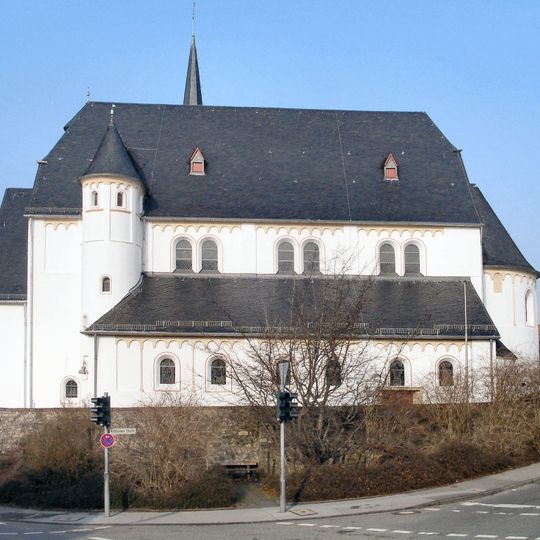
St. Clemens, Catholic church in Bergisch Gladbach, Germany
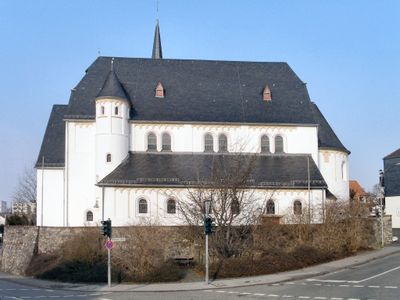
St. Clemens stands on a walled, disused churchyard at the corner of Kempener Straße and Nußbaumer Straße in Paffrath. Its core is a two-bay rubble-stone basilica with a choir square and semicircular apse, fronted by a mid-12th-century west tower with a steep, narrow spire. From 1908 to 1913 Eduard Endler replaced the south aisle with a larger neo-Romanesque hall, and both naves were placed under one high hipped slate roof; the walls are uniformly rendered white.
St. Clemens was first documented in 1160 as property of the Cologne Cathedral chapter, built in the mid-12th century as its own church in Paffrath. In 1803, during the French secularisation, it passed to the Duchy of Berg. By 1900 the church was too small, so pastor Joseph Römer commissioned Cologne architect Eduard Endler to extend it; the foundation stone of the neo-Romanesque south annex was laid on 20 July 1908.
The interior holds three Baroque altars and stained glass windows created by Anton Wendling, which shape how light fills the space when you enter. These artworks remain central to the visual experience of visiting the church today.
The church stands on the corner of Kempener Straße and Nußbaumer Straße, raised on a walled former churchyard, so the entrance is reached by a short rise from the street. The south aisle and three-part west porch added between 1908 and 1913 now cover much of that old burial ground. The building is listed as monument number 26 in Bergisch Gladbach.
The organ history is one of repeated rebuilding: the original Stahlhuth instrument dated from the 1910 extension, was reworked by Johannes Klais of Bonn in 1956, and lost almost all its historic substance in a 1978 rebuild. A 2014 expert report for the parish council found it damaged and technically deficient, leading to a new instrument by Orgelbau Scholz of Mönchengladbach.
The community of curious travelers
AroundUs brings together thousands of curated places, local tips, and hidden gems, enriched daily by 94,505 contributors worldwide.