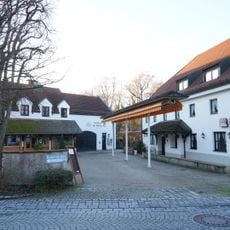
Ismaning Palace, Baroque palace and town hall in Ismaning, Bavaria.
Ismaning Palace is a Baroque palace in Ismaning, Bavaria, that serves as the town hall. It has a garden pavilion and a gatehouse. The palace was built in 1530 in Renaissance style and transformed in Baroque style between 1716 and 1724 under Prince-Bishop Johann Franz Eckher, with contributions from Johann Baptist Zimmermann and builder Dominik Gläsl. In 1816 Eugène de Beauharnais and his wife Auguste Amalia acquired it and had it remodeled by Leo von Klenze.
The building began in 1530 in Renaissance style. Between 1716 and 1724 it received its present Baroque form under architect Johann Franz Eckher, and was later reworked by Leo von Klenze in 1836.
The palace's name recalls the Leuchtenberg line: Eugène de Beauharnais, Napoleon's stepson, and his wife Auguste Amalia, daughter of King Maximilian I of Bavaria, took over the building in 1816. Two halls from their time survive and can still be seen. Since 1934 the building has housed Ismaning's town hall.
The palace functions as the town hall and administrative center, so some areas may not be open to visitors. It is best to check ahead about which sections are accessible and when visits are possible.
The Baroque redesign of 1716–1724 was carried out under Prince-Bishop Johann Franz Eckher with decisive involvement of the painter Johann Baptist Zimmermann and the master builder Dominik Gläsl, who is not recorded as an artist. Two halls from the time of Auguste Amalia survive and are worth seeing.
The community of curious travelers
AroundUs brings together thousands of curated places, local tips, and hidden gems, enriched daily by 93,815 contributors worldwide.