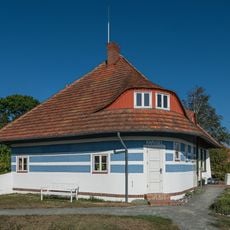
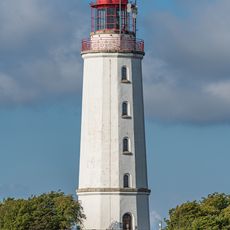
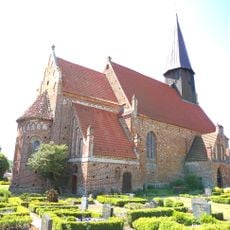
Hiddensee Bird observatory, Bird observatory on Hiddensee Island, Germany.
Hiddensee Bird Observatory is a scientific station of the University of Greifswald on the Baltic island of Hiddensee, run by the Zoological Institute and, since 2007, no longer permanently staffed on the island. It began in 1936 as the Biologische Forschungsanstalt Hiddensee under Richard Stadie, moved in 1951 to the Haus am Meer in Kloster and became the GDR's only purely ornithological research institute and its national ringing centre. Today the Hiddensee ringing centre, under Mecklenburg-Vorpommern's LUNG, is directed from Greifswald, where the Zoological Institute and Museum sits at Soldmannstrasse 23.
The University of Greifswald founded this ornithological station in 1936 as one of the first systematic bird research centers in the region. Since then, it has grown into an internationally recognized facility whose long-term data has shaped our understanding of bird migration patterns across Europe.
The Hiddensee ringing centre issues its own bird rings, and since before 1989 these have marked birds on the Antarctic Peninsula, in Mongolia and on the open sea. The station's work continues under the Beringungszentrale Hiddensee, run since 1994 through an agreement among five German states and based in Kloster.
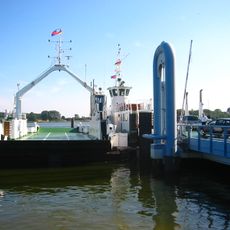
Visitors reach the observatory by taking a ferry from the mainland, as the island is car-free. Once there, bicycles and walking paths make it easy to navigate the island and reach different observation areas.
The Hiddensee ringing centre issued its own bird rings and, before 1989, marked birds beyond Germany: on the Antarctic Peninsula, in Mongolia and on the open sea. Since 1994 the island group has run as a joint facility of the five eastern German states under Mecklenburg-Vorpommern's environment agency, based in Kloster.
The community of curious travelers
AroundUs brings together thousands of curated places, local tips, and hidden gems, enriched daily by 94,228 contributors worldwide.