Stadthaus, Historic building in the Altstadt, Düsseldorf, Germany
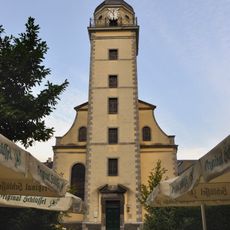
The Stadthaus is a building complex in Düsseldorf's Altstadt, bounded by Mühlenstraße to the west, St. Andreas church to the east, Andreasstraße to the south and Mertensgasse to the west. Its visible wing facing Mühlenstraße dates from around 1710 and adjoins the church directly. The complex, expanded in 1889/91 and 1901/02, has three inner courtyards.
The Jesuit order, active in Düsseldorf from 1619, built the monastery and its gymnasium here between 1622 and 1629; the wing facing Mühlenstraße dates from about 1710. After the order was dissolved in 1773 the property passed to the state and served from 1784 as the Electoral Chancellery, then from 1806 to 1813 as the seat of government of the Grand Duchy of Berg. From 1824 the Prussian Rhine Province installed its royal government, whose president sat here with interruptions until 1911.
The name Stadthaus, used mainly after 1945, reflects the building's civic role after centuries as a Jesuit monastery and school. In the neighbouring Mertensgasse stands the Haus Arche Noah, once owned by Simon van Geldern, an uncle of Heinrich Heine. Nearby, the wine house "Tante Anna" has operated since 1820 on the site of the former Jesuit house chapel.
The Stadthaus occupies the block between Mühlenstraße to the north, St. Andreas to the east, Andreasstraße to the south and Mertensgasse to the west, in Düsseldorf's old town. The complex has three inner courtyards, and the Mühlenstraße wing is the part visible from the street. The neighbouring wine house "Tante Anna" has stood since 1820.
The observatory installed on the monastery's upper floor was used first by the Jesuit priest Ferdinand Orban (1655–1732) and later by the astronomer Johann Friedrich Benzenberg; it survived until about 1953, long after the building had become an administrative seat.
The community of curious travelers
AroundUs brings together thousands of curated places, local tips, and hidden gems, enriched daily by 93,894 contributors worldwide.