Nuclear waste storage Gorleben, Interim radioactive waste repository in Lower Saxony, Germany.
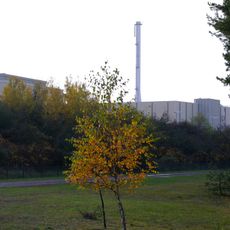
The Brennelemente-Zwischenlager Gorleben (BZG), formerly Transportbehälterlager Gorleben, is a central interim store for spent fuel and vitrified high-level waste about 2 km south of Gorleben in the Lüchow-Dannenberg district. Its main building is a 182 m long, 38 m wide and 20 m high hall with 0.5 m thick reinforced concrete walls, where casks stand cooled by natural air convection and linked to a leak-monitoring system. The site also holds the Abfall-Zwischenlager Gorleben for low- and intermediate-level waste and the Pilot-Konditionierungsanlage.
Construction of the interim storage facility was completed in 1983 after about two years of building, under a first licence allowing 1,500 tonnes of heavy metal of spent fuel. Protests in September 1982 saw water cannon cause rib fractures and kidney injuries among seated demonstrators, and legal challenges reached the Federal Constitutional Court. First emplacements followed in 1995; in June 1995 the licence was extended to 3,800 tonnes of heavy metal on 420 storage positions, and in 1996 the first vitrified high-level waste casks arrived from French reprocessing. The licence runs until 31 December 2034; on 29 June 2026 the operator BGZ applied for a 20-year extension.
The name Gorleben became a byword for the German nuclear dispute: the first major protests accompanied construction around 1982, when water cannons of the type WaWe 6 caused broken ribs, back bruises and kidney injuries among seated demonstrators, and legal challenges went as far as the Federal Constitutional Court. The site is still a rallying point for the anti-nuclear movement.
The storage hall stands about 2 km south of Gorleben village in the Lüchow-Dannenberg district; the site itself is fenced and closed to visitors. The nearest reference point for orientation is the village of Gorleben, where the NLWKN also runs a measuring station for natural background radiation. The hall is 182 m long, 38 m wide and 20 m high.
The storage hall is 182 m long, 38 m wide and 20 m high, with 0.5 m thick reinforced concrete walls and a concrete slab roof; the casks inside are cooled by natural air convection and permanently connected to an electronic leak-tightness monitoring system. The licence runs until 31 December 2034, and on 29 June 2026 the operator BGZ applied for a 20-year extension.
The community of curious travelers
AroundUs brings together thousands of curated places, local tips, and hidden gems, enriched daily by 93,640 contributors worldwide.