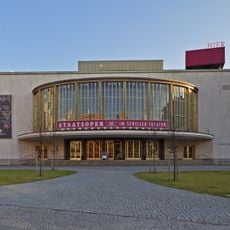
Tribüne, Theatre in Charlottenburg, Germany.
The Tribüne was a theatre at Otto-Suhr-Allee in Berlin-Charlottenburg, near what is now Ernst-Reuter-Platz. Its auditorium was originally the assembly hall of the Ottilie-von-Hansemann-Haus, a girls' secondary school built in 1915 by architect Emilie Winkelmann, and held around 300 seats. The venue operated from 1919 to 2008 and briefly reopened from 2009 to 2011.
Founded in September 1919 as a political-expressionist stage, the Tribüne opened with two plays by Walter Hasenclever. Its breakthrough came on 30 September 1919 with the premiere of Ernst Toller's Die Wandlung, directed by Karlheinz Martin and starring Fritz Kortner. After 1945 it was the first Berlin theatre to reopen, on 1 June 1945 under Viktor de Kowa. It closed on 31 December 2008 and was briefly revived from 2009 to 2011.
The theatre's name refers to the stage as a tribune, a platform for political speech: it opened in 1919 with expressionist plays, and Dadaists such as George Grosz and Raoul Hausmann staged audience-baiting performances there. Later decades brought boulevard comedies, and from 2000 the revue Die verbrannten Dichter, honoured with a critics' prize, addressed writers whose works were burned under the Nazis.
The theatre stood at Otto-Suhr-Allee in Charlottenburg, near what is now Ernst-Reuter-Platz, then called Am Knie. It closed on 31 December 2008 after the boxer musical Der Kampf des Jahrhunderts; a brief reopening ran from September 2009 to 2011. The hall, once the assembly room of the 1915 Ottilie-von-Hansemann-Haus girls' school, held around 300 seats.
The hall was originally the assembly hall of the Ottilie-von-Hansemann-Haus, a girls' secondary school built in 1915 by architect Emilie Winkelmann, and held around 300 seats. After the 1945 reopening, audiences paid with food, briquettes, cigarettes or stockings.
The community of curious travelers
AroundUs brings together thousands of curated places, local tips, and hidden gems, enriched daily by 93,359 contributors worldwide.