Nürnberg South Cemetery, Cemetery and architectural heritage monument in Nuremberg, Germany
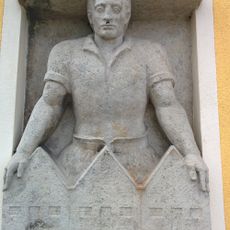
Nürnberg South Cemetery is Nuremberg's largest cemetery, laid out from 1913 on wooded ground annexed in 1905 and modelled on Munich's Waldfriedhof. Its central domed building has a pale stone facade with a round-arched portal, a sculpted figure in a niche and a grey dome with a lantern; a square clock tower and a long colonnade of square pillars with a moss-covered roof frame the gravel court.
A second municipal cemetery was proposed in 1899, and the South Cemetery was laid out in forest annexed to Nuremberg in 1905, modelled on Munich's Waldfriedhof. It opened on 1 September 1913. After the First World War an honorary cemetery was incorporated, and repeated extensions made it Nuremberg's largest cemetery.
The cemetery serves as a resting place for people who shaped Nuremberg's story, with graves reflecting different periods and professions. Visitors can find memorials to artists, scholars, and citizens who influenced the city's development.
The cemetery is accessible through multiple entrances, with parking areas and public transportation stops near the main gate. Visitors should wear sturdy shoes, as pathways can vary depending on weather conditions.
In the southern part, near the war graves and those of the victims of the British air raid of 2 January 1945, stand two sandstone towers said to be built from blocks of Nuremberg's destroyed synagogue. Three bells hang between them on wooden yokes; the north pillar reads "Aufgerichtet 1957–58", the south one names 6,621 victims of 1941–1945.
The community of curious travelers
AroundUs brings together thousands of curated places, local tips, and hidden gems, enriched daily by 95,041 contributors worldwide.