Villa Böhm, Cultural heritage villa in Neustadt an der Weinstraße, Germany
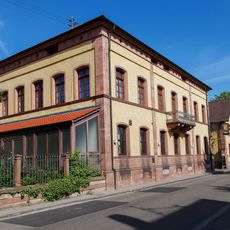
Villa Böhm is a former grand-bourgeois villa on the Haardt slope, set in a small park between Maximilianstraße and Villenstraße, with entrances on both streets. Built from 1886 under architect Ludwig Levy, it is mainly of Königsbacher sandstone in Italian Neorenaissance style, with decorative paintings on stucco ceilings and Rococo elements inside. Since 1970 it has housed the Neustadt an der Weinstraße city museum.
The villa was built from 1886 under architect Ludwig Levy for banker Adolf Dacqué. Around 1900 the wine-merchant family Hoch-Böhm moved in, giving the house its name. In 1935 the property was sold to the city and served until 1944 as the office of Nazi Gauleiter Josef Bürckel. After the war it housed the US and French military administrations before passing to Rhineland-Palatinate in 1956.
The name comes from the wine-merchant family Hoch-Böhm, who moved in around 1900. Since June 2005 civil weddings have been held in the villa, and in summer the Neustadt theatre group performs its summer theatre in the park.
The villa has entrances on both Maximilianstraße and Villenstraße, with the former champagne cellar Carstens opposite the lower entrance. The park hosts the Neustadt theatre group's summer theatre. Since June 2005, civil weddings have taken place inside the villa.
In the garden lies the grave slab of Heilmann von Wattenheim, provost and papal legate, who died in 1411; it was moved here from the Neustadt Stiftskirche. The slab is a piece of medieval sculpture a visitor can examine up close, separate from the museum's exhibits inside the villa.
The community of curious travelers
AroundUs brings together thousands of curated places, local tips, and hidden gems, enriched daily by 94,641 contributors worldwide.