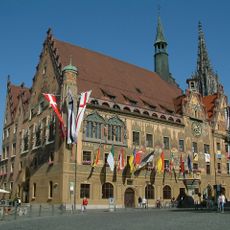
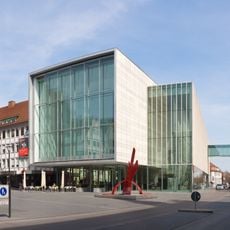
Ulmer Museum, Archaeological and art museum in Ulm, Germany
The Museum Ulm, founded in 1924, is the city's museum of art, archaeology and urban history. Its permanent archaeological display, redesigned in 2014, centres on the Lion-man, a mammoth-ivory figure reassembled in 2012/13 from over 300 fragments. Late Gothic Ulm School sculpture and painting, including works by Hans Multscher and Michel Erhart, lead on to the Kurt Fried Collection of post-1945 European and American art in the Fried-Bau extension opened in 1999.
Julius Baum, a conservator and university professor, became the museum's founding director on 1 April 1924; his successor Erwin Treu said an institute emerged from a junk room. In 1937 the Nazi campaign against "degenerate art" seized and mostly destroyed the museum's large modern art collection. The archaeological display was redesigned in 2014 after more fragments of the Lion-man were recovered in the Lone Valley.
The museum holds works by Ulm masters from the late Middle Ages, including sculptures and panel paintings that show how the city was once a leading center for Gothic art. Walking through the rooms, visitors can see how closely craft and artistic practice were connected in this region.
The museum entrance is at Marktplatz 9 in Ulm's old town, close to the Ulm Minster. The building is wheelchair accessible. The archaeological permanent exhibition was redesigned in 2014, and the extension building, the Fried-Bau, opened on 14 November 1999 for the collection of European and American art after 1945.
The most talked-about object in the collection is the Lion Man, a figurine carved from mammoth ivory and found in a cave in the Swabian Alps, dating back around 35,000 years. It is considered one of the oldest known figurative sculptures ever discovered anywhere in the world.
The community of curious travelers
AroundUs brings together thousands of curated places, local tips, and hidden gems, enriched daily by 93,360 contributors worldwide.