Villa Halstenbach, Timber-framed villa in Wuppertal, Germany
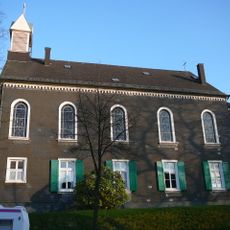
Villa Halstenbach is a two-storey timber-framed villa at Am Diek 47 in Wuppertal's Wichlinghausen district, clad in slate. Its wide overhanging gable roof has a central dormer gable with decorative boards, and the street entrance sits in a Renaissance-style central risalit. A northern wing added in 1896 has a plastered facade, natural-stone window and door surrounds, and a Romanesque-style bay with columns and round arches.
The structure was built between 1806 and 1807 by Peter Mittelsten Scheid. Willy Halstenbach purchased it in 1922 and established it as his family home, giving the villa its current name.
Willy Halstenbach, a rubber-band and machine factory owner, was a presbyter of the Evangelical Reformed congregation of Barmen-Gemarke and a supporter of the Confessing Church. He offered his house for secret meetings where Karl Barth, Martin Niemöller, Johannes Schlingensiepen and Hanns Lilje gathered; forbidden theological exams were held there undetected by the Gestapo, as was help for Jewish neighbours.
The building was converted into individual apartments and flats in 1980, with a retirement home constructed in the rear section of the grounds. Visitors should keep in mind that the property is now privately owned or operates as a residential complex.
The 17 August 1945 meeting in the Herrenzimmer brought together Ernst Plutte, Emil Marx, Otto Schmidt, Klaus Brauda, Gustav Theill, Robert Pferdmenges and later Federal President Gustav Heinemann, alongside Willy Halstenbach. According to Hermann Lutze's recollection, only during the discussion did the decision mature to found a new Christian collective party, the CDP, which formally became the CDU on 2 September 1945 in Cologne.
The community of curious travelers
AroundUs brings together thousands of curated places, local tips, and hidden gems, enriched daily by 93,814 contributors worldwide.