Villa Köster, villa in Neumünster, Germany
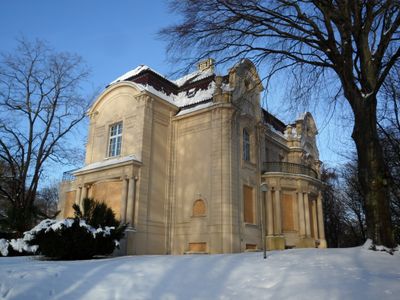
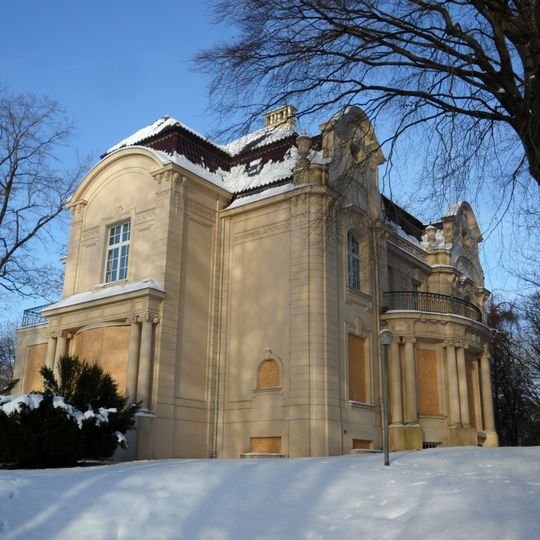
Villa Köster is a two-storey neo-baroque stucco building under a hipped roof, built in 1902. Its garden side has a ground-floor hall with paired columns and a balcony between risalits with curved gables. The original wooden interior survives largely in the staircase hall, and a chestnut avenue serves as the drive.
Built in 1902 for the textile merchant Friedrich Hanssen, the villa was designed by the Hamburg architects Lundt & Kallmorgen on a rise in Rencks Park beside the Schwale. The leather-factory founder Emil Köster later bought it and lived there with his family. From the city's ownership until early 2012 it housed part of the Klaus-Groth-Schule, which stopped using it after the 2007/08 school year; it was sold in December 2011 and, after renovation, serves as a residential and office building.
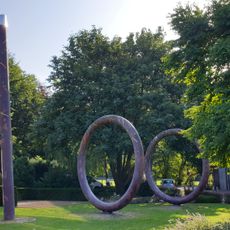
The villa's name comes from Emil Köster, founder of a leather factory, who bought the house after textile merchant Friedrich Hanssen had it built in 1902. The chestnut avenue leading to the house is protected along with the building, and the sculptures in Rencks Park are likewise entered in the monument list.
Villa Köster stands at Parkstraße 11 in Rencks Park, on a rise above the Schwale in Neumünster's centre. The chestnut avenue that serves as its drive is itself a listed monument, and the park holds numerous listed sculptures. The building is now used as a residence and office, so visitors see it from the park paths and the avenue rather than inside.
The villa served as a school building until 2008 before the Klaus-Groth-Schule relocated to larger premises and the property was sold. Following careful renovation, it now functions as both residence and office space while retaining its historical character.
The community of curious travelers
AroundUs brings together thousands of curated places, local tips, and hidden gems, enriched daily by 94,532 contributors worldwide.