Wangenheim-Palais, Palace in Mitte, Hannover, Germany.
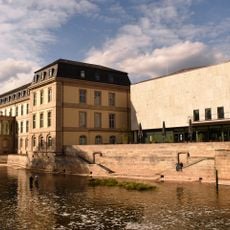
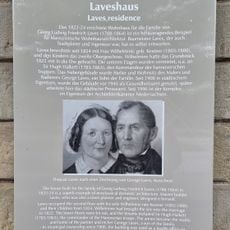
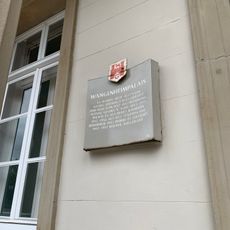
The Wangenheim-Palais is a three-storey neoclassical building on Friedrichswall, built 1829–1832 to plans by court architect Georg Ludwig Friedrich Laves for Georg Christian von Wangenheim. Its facade carries the coat of arms of the Brückmühle in the gable, moved there after that mill was demolished for the Leibnizufer road.
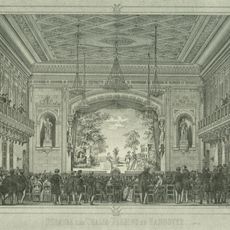
Georg Ludwig Friedrich Laves designed the palace, built 1829–1832 for Georg Christian von Wangenheim; Georg Moller likely advised. After Georg V took the throne in 1851, the crown endowment bought it as a royal residence, and he lived there for ten years. The city bought it in 1862, and after Ludwig Droste's conversion it served as Rathaus from 1863 until 1913, when the New Town Hall opened opposite. A 1943 air raid gutted it; it was rebuilt and has housed the Lower Saxony economics ministry since 1957.
The building's name comes from Georg Christian von Wangenheim, the court marshal who commissioned it in 1829. Since 1957 it has housed the Lower Saxony Ministry of Economics. On the facade gable, visitors can see the city coat of arms of the Brückmühle mill, moved here when that building was demolished for the Leibnizufer road.
The building now houses the Ministry of Economy, Labour and Traffic of Lower Saxony and functions as an administrative center. Visitors should know that it is an active government building and access may be restricted.
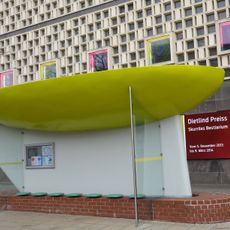
The gable of the facade carries the city coat of arms of the Brückmühle mill, moved there after the mill was demolished for the Leibnizufer road. From 1994 to 2013 a bus stop shaped like a sailing boat, designed by Massimo Iosa Ghini for the BUSSTOPS art project, stood opposite the palace; in 2013 it was moved across the street to the Museum August Kestner.
The community of curious travelers
AroundUs brings together thousands of curated places, local tips, and hidden gems, enriched daily by 94,553 contributors worldwide.