Weingartener Moor-Bruchwald Grötzingen, Protected wetland area in Karlsruhe, Germany.
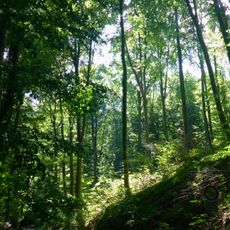
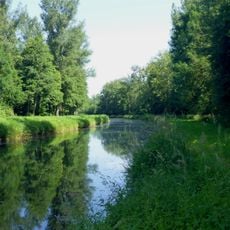
Weingartener Moor-Bruchwald Grötzingen is a 256-hectare nature reserve between Weingarten and Grötzingen, the largest surviving lowland bog in the eastern Upper Rhine rift. Open water with white water lilies and reed beds of sedge and bulrush lies beside alder-ash swamp forest and hornbeam-oak woodland. A railway built in 1842 cuts the reserve in half.
The bog formed about 7,000 years ago when rivers Kinzig and Murg altered their course and influenced the Rhine landscape. These geological changes created the marshy conditions that characterize the area today.
The reserve's name combines Weingarten and Grötzingen, the two municipalities it lies between, with Bruchwald referring to the alder carr woodland. In spring, wild garlic (Allium ursinum) flowers in the undergrowth, and the alder-ash carr is among the largest near-natural forests in western Germany. The Kinzig-Murg-Rinne fen has been part of the Natura 2000 network since 2006.
The reserve lies between Weingarten and Grötzingen, west of the B3 and crossed by the Karlsruhe–Heidelberg railway line built in 1842, so the two halves are reached separately. A tunnel beneath the B3 lets amphibians cross during their migrations. The open water and sedge beds of the Grötzinger Baggersee form the northeastern part of the protected area.
The Karlsruhe–Heidelberg railway, built in 1842, cuts the reserve in two. Since 2006 the bog has formed part of the Natura 2000 habitat area Kinzig-Murg-Rinne zwischen Bruchsal und Karlsruhe. Look for the rare green sickle-moss among the bryophytes, and for bear garlic flowering in spring.
The community of curious travelers
AroundUs brings together thousands of curated places, local tips, and hidden gems, enriched daily by 94,553 contributors worldwide.