Basilica of the Visitation of Our Lady, Werl, Catholic pilgrimage church in Werl, Germany.
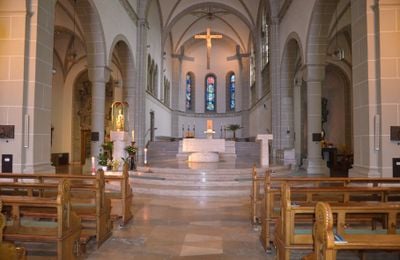
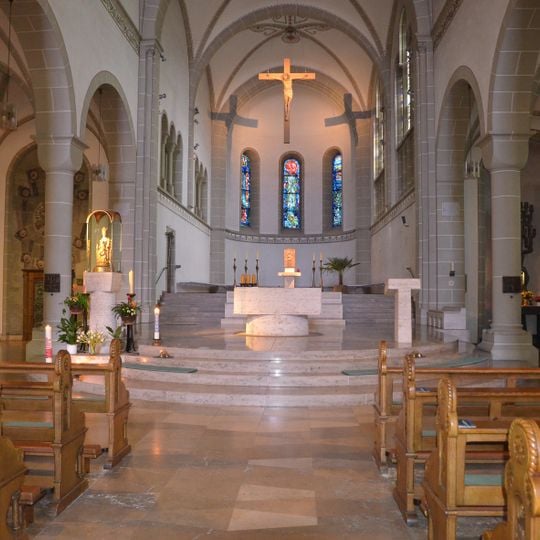
The Basilica of the Visitation of Our Lady is a Neo-Romanesque church of light grey stone, built 1904–1906 to plans by Wilhelm Sunder-Plaßmann. Its tall interior rises through pointed arches to a vaulted ceiling; broad shallow steps lead to a pale stone altar slab on a cylindrical base. A wooden crucifix hangs beneath the chancel arch, flanked by two plain crosses, with three narrow stained-glass windows behind the altar.
The Neo-Romanesque church was built from 1904 to 1906 to plans by Münster cathedral architect Wilhelm Sunder-Plaßmann, using Rüthener Grünsandstein for the exterior. Bishop Karl Joseph Schulte consecrated it on 24 May 1911. Pope Pius XII elevated it to a minor basilica on 16 October 1953.
The venerated image is the 12th-century Virgin of Werl, called Trösterin der Betrübten (Consolation of the Afflicted), brought from Soest to Werl in 1661. Pope Pius X crowned it canonically on 13 August 1911, and the decree was read by Franciscan bishop Giuseppe Bernardo Doebbing. Franciscans have guarded the pilgrimage since 1848.
The church is reached by six stone steps leading to a terrace-like forecourt, and the complex is entered through a stairway to the atrium, a courtyard flanked by arcades. The crypt, built in 1961 for smaller services, is accessed through a door made by Josef Baron in 1999. The three apsidal windows are best seen when daylight enters from outside.
The basilica houses a 12th-century statue of the Virgin of Werle that underwent papal coronation in 1911 by Pope Pius X. This statue is not merely a work of art but serves as one of the main focal points for pilgrims attending religious ceremonies here.
The community of curious travelers
AroundUs brings together thousands of curated places, local tips, and hidden gems, enriched daily by 95,059 contributors worldwide.