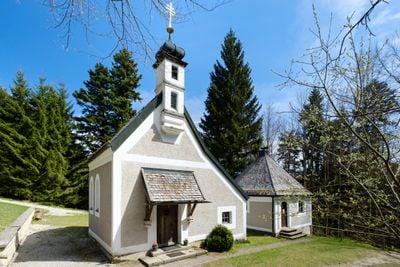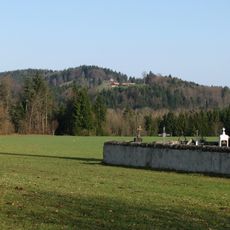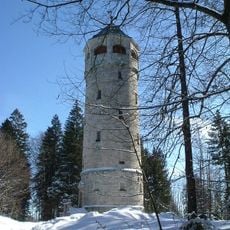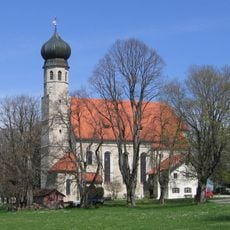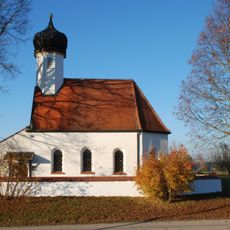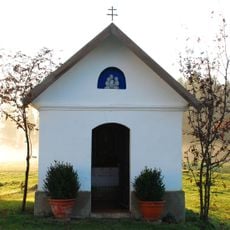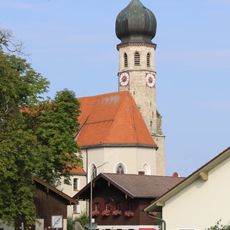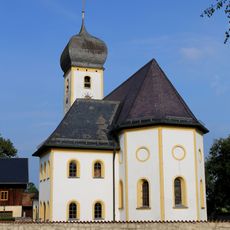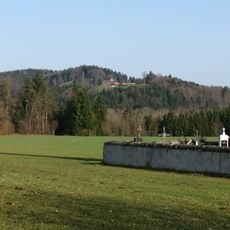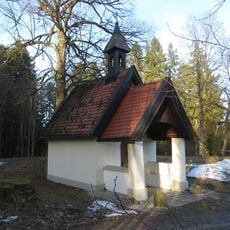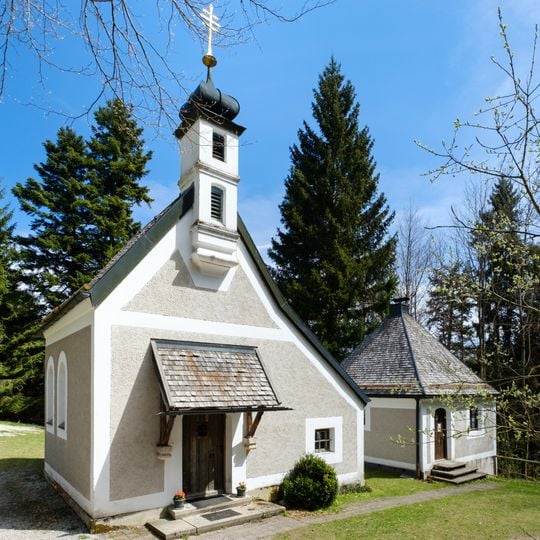
Wallfahrtskapelle Nüchternbrunn, Baroque pilgrimage chapel in Warngau, Germany.
The Wallfahrtskapelle Nüchternbrunn is a simple Baroque hall church about seven metres long and just over three metres wide, with a rounded apse and a small sacristy annex. Its shingled west gable carries a half-oriel, half-ridge turret with an onion dome and a bell. The plastered nave has three arched windows and two small round windows in the apse; inside, pews seat about 16 people.
Around 1700 a wooden hermitage stood by the spring; by 1710 the provost of Weyarn Abbey obtained permission to build a chapel and permanent hermitage, financed by court secretary Urban Höger of Osterwarngau. The simple Baroque chapel was dedicated to the Five Wounds of Christ. It burned around 1770 and was rebuilt with funds from local farmers, notably Georg Heiler of Schmiedham. After a fire in 1940, reconstruction began in 1945/46 to plans by Richard Steidle.
The chapel takes its name from a nearby spring that held special meaning in local popular piety and folk traditions. Visitors can still sense how this water source shaped the spiritual life that has flourished here for centuries.
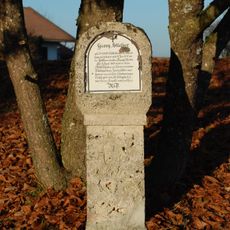
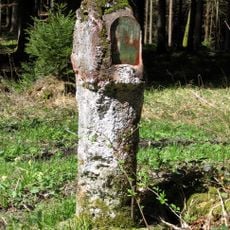
The chapel is open only on summer Sunday afternoons for rosary prayer; Mass is held twice a year, at the end of June and on 15 September. A Stationsweg with 15 naive-style painted panels leads up from Osterwarngau, and the Rosary Way (Taferlweg) shows the fifteen traditional mysteries. The chapel also lies on the Meditationsweg, part of the Jakobsweg network signposted from Bad Aibling via Irschenberg and Weyarn to Holzkirchen.
The chapel's name refers to a healing spring that was already venerated in folk piety before the building was constructed. This link between the water source and the sacred place makes it a special testament to Bavaria's religious landscape.
The community of curious travelers
AroundUs brings together thousands of curated places, local tips, and hidden gems, enriched daily by 95,031 contributors worldwide.