Wallfahrtskirche, Catholic pilgrimage church in Hessenthal, Germany.
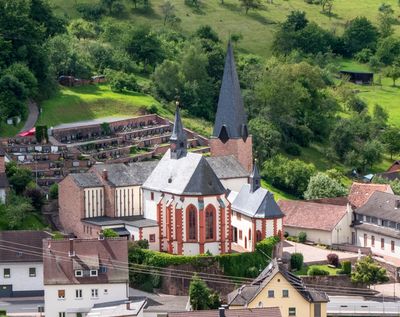
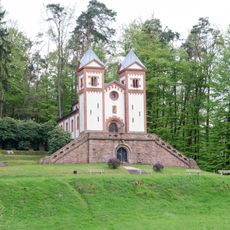
The Wallfahrtskirche in Hessenthal is a three-part pilgrimage complex: a late-Gothic chapel dated 1439 by its choir keystone, a smaller 1454 Gnadenkapelle joined to its north side, and a 1954 hall church by Würzburg cathedral architect Hans Schädel. The old chapel has lancet tracery windows, a flat ceiling and a choir with a five-eighth close under a late-Gothic net vault. The photograph shows the red sandstone tower with grey-slate spire, the white nave with red quoins and tracery, and the smaller clock spire.
A church in Hesilndal is documented in 1293, though nothing survives from that building. The late-Gothic pilgrimage chapel was built in 1439, dated by a keystone in the choir vault, and the smaller Gnadenkapelle was added on its north side in 1454, linked by a defensive wall. Both chapels gained their naves in the 17th century. After the Second World War, returning pilgrims overcrowded the site, so Würzburg cathedral architect Hans Schädel added a new hall church in 1954, demolishing part of the old nave and the hillside Hochkreuz chapel. Renovations followed in 1968/70, 1978/79 and for the 700th anniversary in 1993.
Pilgrimages are held five times a year: at Easter, Pentecost, the Assumption (15 August), the Nativity of Mary (8 September) and the Presentation of Mary (21 November), each preceded by a candlelit procession the evening before. The Marian statue venerated here is a late-Gothic Pietà of around 1480, integrated in 1718 into a Baroque altar from Aschaffenburg.
The church stands on a terraced hillside above cemetery walls, so the approach involves steps or a slope. The old pilgrimage chapel is now entered only from inside Hans Schädel's 1954 hall church. Pilgrimages with candlelit processions on the eve are held five times a year: Easter, Pentecost, Assumption (15 August), Nativity of Mary (8 September) and Presentation of Mary (21 November).
The 1954 hall church by Würzburg cathedral architect Hans Schädel has a flat prestressed-concrete ceiling from which glass pendant lights hang on long cords, supplementing daylight from broad glazing bands on dull days. Along the right inner wall runs a neo-expressionist Stations of the Cross in grey, white and brown, made in 1967 by Aschaffenburg artist Siegfried Rischar.
The community of curious travelers
AroundUs brings together thousands of curated places, local tips, and hidden gems, enriched daily by 94,254 contributors worldwide.