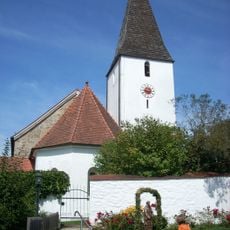
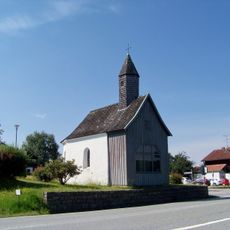
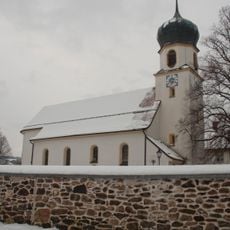
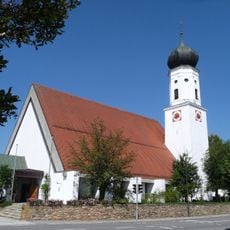
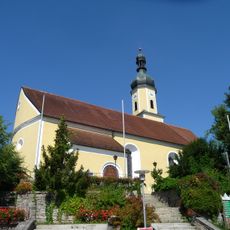
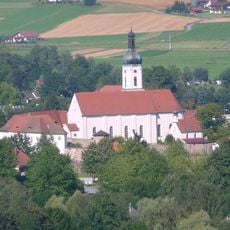
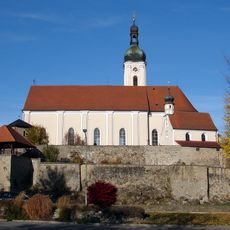
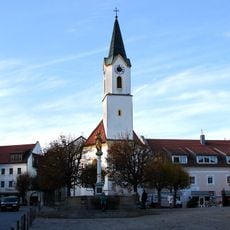
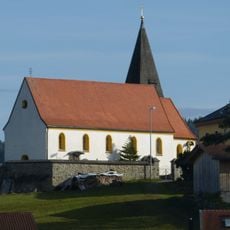
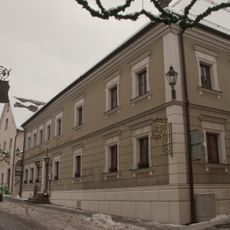
Wallfahrtskirche Mariä Himmelfahrt, Catholic pilgrimage church in Bad Kötzting, Germany.
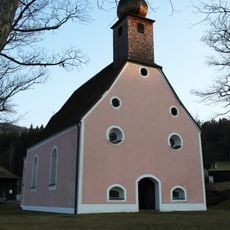
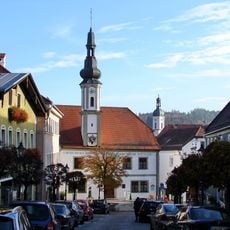
Wallfahrtskirche Mariä Himmelfahrt is a single-nave hall church with a flat barrel vault, built from 1750 to 1765 in Weißenregen, part of Bad Kötzting. Its tower has an upper storey crowned by an onion dome with a lantern. The nave ceiling once carried a large fresco of the Assumption, overpainted in 1880 and again in 1912; the choir ceiling shows the Birth of Mary.
A legend tells of a miraculous image saved from the iconoclasm in Nabburg and hung on an oak that burned in 1584 while the image survived. Niederaltaich Monastery built a chapel in Weißenregen in 1593, replaced by a larger one in 1611 and extended in 1659–1660. The present late-Baroque church was built from 1750 to 1765 and consecrated on 1 May 1765 by Regensburg auxiliary bishop von Wolframsdorf.
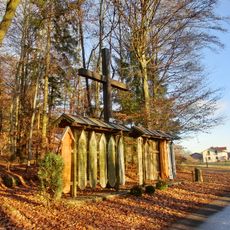
The pilgrimage centres on a 45 cm wooden figure of Mary from the early 14th century, kept in the high altar; the Christ Child, crowns and silk garments were added in the Baroque period. Legend tells that the image survived the burning of an oak in 1584 and was then placed in a wayside shrine. Votive pictures hang in the church porch.
The church stands in Weißenregen, a district of Bad Kötzting, not in the town centre, so it is reached by road rather than on foot from Kötzting. The sources record no barrier-free access, so visitors should not assume step-free entry. The nave is a single hall under a flat barrel vault, and the pulpit and altars are best seen in the morning light from the south windows.
The pulpit was handcrafted in 1758 by artist Johann Paulus Hager and features carved biblical scenes, including the prophet Jonah in the belly of a fish. This detailed carving represents a rare example of 18th-century craftsmanship and artistry.
The community of curious travelers
AroundUs brings together thousands of curated places, local tips, and hidden gems, enriched daily by 94,117 contributors worldwide.