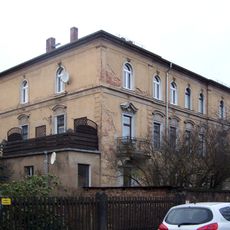
Villa Shatterhand, Renaissance villa in Radebeul, Germany.
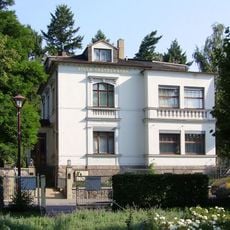
Villa Shatterhand is a two-storey villa with an asymmetrical facade and a flattened hipped roof, built by the Ziller brothers' firm between 1893 and 1894. The rendered building on a rubble-stone base has window surrounds with pilasters, blind balustrades and console-supported canopies, plus a console frieze at the eaves. A veranda on the right street side was later raised, and the rear veranda now holds the museum entrance.
The Serkowitz builders Gebrüder Ziller applied in 1890 to build a two-storey villa on Kirchstraße 5; after approval in 1893 it was completed and inspected in 1894. Karl May bought the finished property in 1896 and had the lettering "Villa Shatterhand." mounted on the street facade that same year. His widow Klara had the Villa Bärenfett built in the garden in 1926, and the Karl May Museum opened in an annex in 1928. The villa passed to the Karl May Foundation on her death in 1944 and has housed the biographical museum department since 1985.
The villa was home to a renowned author whose literary works centered on travel adventures and distant lands. Visitors can see today the personal belongings and collections that reflected his fascination with the world.
The museum entrance is at the rear veranda added in 1914 and raised in 1950. The villa's upper floor, reachable only by stairs, holds the biographical exhibition; the garden with the 1926 Villa Bärenfett blockhouse lies behind the house.
The wooden blockhouse in the garden, Villa Bärenfett, was built in 1926 for Patty Frank, who lived there as a caretaker of Karl May's collection. An annex to this log cabin housed the Karl-May-Museum, opened in 1928. The museum's entrance today is in the rear veranda added in 1914 and raised in 1950.
The community of curious travelers
AroundUs brings together thousands of curated places, local tips, and hidden gems, enriched daily by 94,533 contributors worldwide.