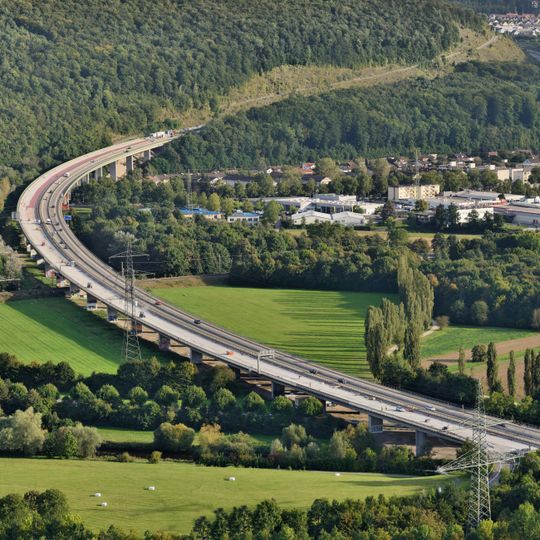
Wiesentalbrücke, Prestressed concrete road bridge in Lörrach, Germany.
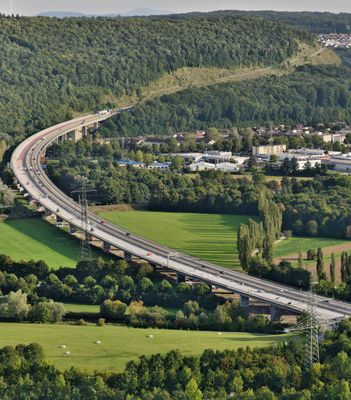
The Wiesentalbrücke is a 1,201-metre prestressed concrete road bridge on the A 98 in Lörrach, the third-longest road bridge in Baden-Württemberg. Its four-lane deck runs in a curve and rises southward toward the slope, crossing the Wiese, the B 317, the Grütt landscape park and the Wiesentalbahn. The hollow-box superstructure rests on piers founded to resist earthquakes.
Planning and construction began in the 1970s, with workers discovering historical cannonballs from nearby Rötteln Castle during groundwork. The project represented a major infrastructure development for the region.
In summer 2010 the city of Lörrach officially released most of the bridge's pillars for legal graffiti, and the resulting pillar paintings became known beyond the region as the Bridge-Gallery. The works are painted on the concrete piers beneath the A 98 motorway deck.
The bridge carries the four-lane A 98 in a curve that climbs southward toward the hillside, crossing the Wiese, the B 317, the Grütt landscape park and the Wiesentalbahn. An automatic counting station at the east portal records traffic; in 2020 about 23,000 vehicles used it daily, roughly a tenth of them heavy goods vehicles. The pillars are best seen from the paths in the Grütt park below.
The bridge was built with special reinforcements to withstand earthquakes, as the region sits in one of Germany's most active seismic zones. This engineering feature is not immediately visible but shapes the internal structure of the work.
The community of curious travelers
AroundUs brings together thousands of curated places, local tips, and hidden gems, enriched daily by 94,557 contributors worldwide.