Wasserkunstanlage Paradies, Water art installation and park in Baden-Baden, Germany.
Wasserkunstanlage Paradies is a park with water installations and arcaded structures that rises across different elevation levels in Baden-Baden. Semicircular basins and cascading fountains guide water downward while villas on the hillside maintain a balanced design.
Around 1900 Baden-Baden released a 1.5-hectare slope on the Annaberg for a garden-city villa district modelled on Hellerau, but the First World War stalled the plan. From 1921 Professor Max Laeuger took over and used the gradient for a water-art installation with stairways, wall fountains, basins and benches, completed in 1925 after Italian Renaissance gardens. Decline followed in the 1950s and 1960s, when demolition was briefly considered; the 1981 Landesgartenschau prompted restoration, and the grotto was repaired in 2008.
At the centre of the complex, a stone tablet bears Conrad Ferdinand Meyer's poem "Der römische Brunnen", about a Roman fountain. The poem describes water rising, spilling and resting in a basin, matching the cascades around it. The tablet sits by the central water staircase, where the water steps down between symmetrically placed villas.
Buses 204 and 205 stop at both the upper and lower sections, making access straightforward from downtown. Walking through the levels at your own pace lets you see how the water flows and changes at each point.
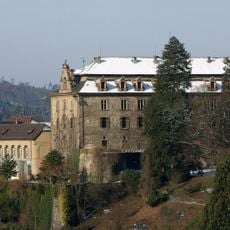
From different spots in the installation, views open toward the Old Town, the Collegiate Church tower, and the New Castle across Baden-Baden. The placement and elevation of the water features were deliberately arranged to frame these sightlines.
The community of curious travelers
AroundUs brings together thousands of curated places, local tips, and hidden gems, enriched daily by 95,462 contributors worldwide.