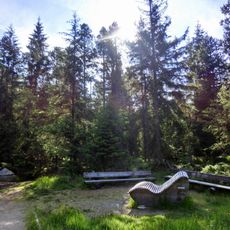
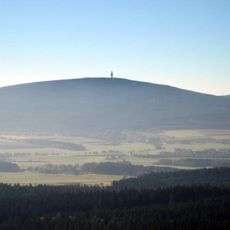
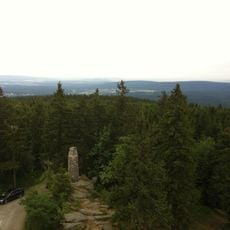
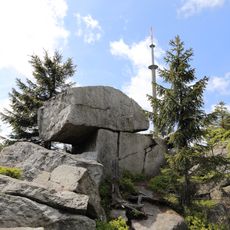
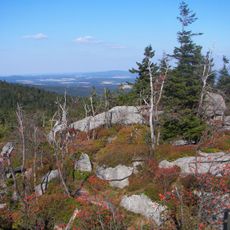
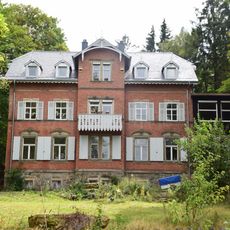
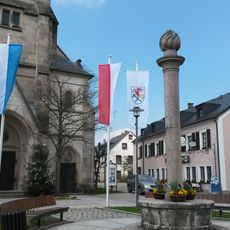
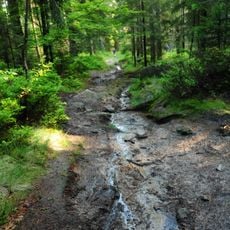
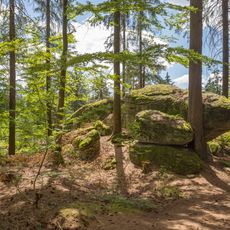
White Main Spring, Natural spring in Bischofsgrüner Forst, Germany.
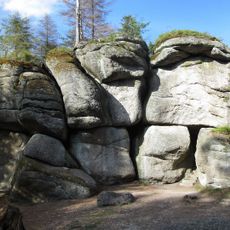
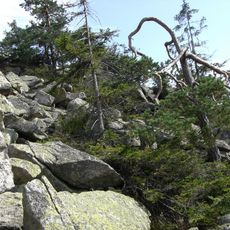
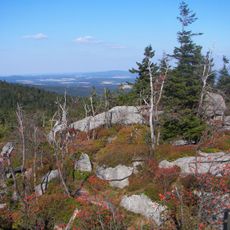
The White Main Spring is a natural water source in Bischofsgrüner Forst that emerges directly from the forest floor. It measures roughly one meter across, sits surrounded by coniferous trees at an elevation of about 890 meters, and produces clean, cold water year-round.
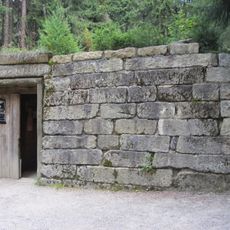
Margrave George Frederick Charles of Brandenburg-Bayreuth had the spring enclosed in granite blocks bearing the Hohenzollern coat of arms in 1717 and fixed it as the source of the Main. The enclosure was renewed in 1827, when a polished syenite slab inscribed WEISSMAINSQUELLE was added. In 1785 Goethe instead regarded the Seehausbrunnen near the Schneeberg as the Main's source. The spring dried up in the hot summer of 1947.
The spring is a station on the Quellenweg (Spring Way) maintained by the Fichtelgebirge Club, a trail linking springs of the range. Its water is called white because the granitic subsoil keeps it light and clear, unlike the Red Main. The name Fürstenbrunnen recalls the margrave's 1717 enclosure.
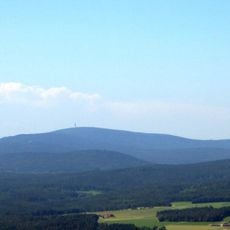
The spring lies at 887 metres on the eastern slope of the Ochsenkopf, in the unincorporated Bischofsgrüner Forst. It is a station on the Quellenweg (Spring Way) maintained by the Fichtelgebirge Club, so follow that trail's markers. The granite surround and the polished syenite plaque inscribed WEISSMAINSQUELLE mark the spot.
On the Ochsenkopf, the European Watershed runs between this spring, whose water reaches the North Sea via the Rhine, and the nearby Fichtelnaab Spring, which drains through the Danube into the Black Sea. The spring is recorded as Geotope 472Q003 by the Bavarian State Office for the Environment.
The community of curious travelers
AroundUs brings together thousands of curated places, local tips, and hidden gems, enriched daily by 93,459 contributors worldwide.