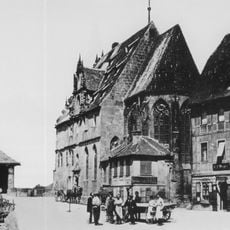
Wilhelmskanal, Canal structure in Heilbronn, Germany.
Wilhelmskanal is a waterway in Heilbronn that links the Neckar River through artificial channels and guides boats over multiple locks. The system allows river traffic between different sections and shapes the city's landscape with its waterside structures.
Wilhelmskanal was opened on 17 July 1821 by King Wilhelm I, after whom it is named, and gave shipping a way past the weirs and mills of the Neckar's old course at Heilbronn. Work began on 11 March 1819, when 150 convicts from Hohenasperg started digging the lock pit; 800 fir piles had to be driven into the soft ground. The 430 m canal, with a 37.25 m chamber lock, was built under Karl August Friedrich von Duttenhofer's plans and cost about 171,000 gulden.
The canal's name honours King Wilhelm I, who opened it on 17 July 1821. Its upper end was closed by an intake gate against floods and ice, and the widened "Schiffsbehälter", 86 m long and 16 m wide, served as a loading basin with a crane, linked to the roads by bridges.
Paths along the canal are popular with cyclists and walkers for outings of varying lengths. The waterside area is easy to reach and offers quiet routes through the city.
The lock chamber measured 37.25 m long, 4.60 m wide and 2.57 to 4.87 m deep, with mitre gates weighing 3.7 tonnes; it could be filled in eight to ten minutes. Its floor rests on 800 pine piles driven into unstable ground, topped by a timber grid and a 16.6 cm caulked pine deck.
The community of curious travelers
AroundUs brings together thousands of curated places, local tips, and hidden gems, enriched daily by 92,842 contributors worldwide.