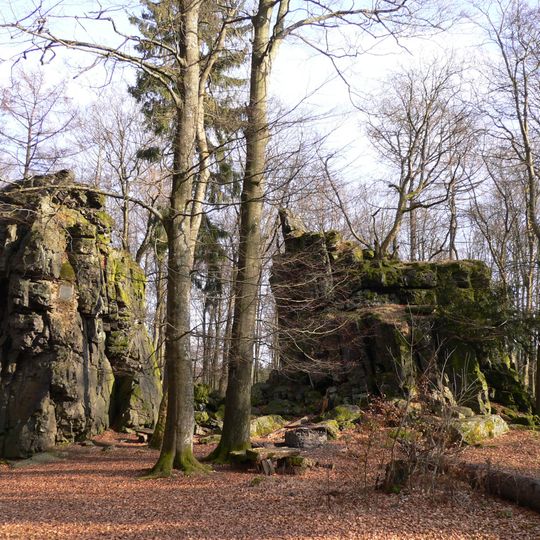
Wilhelmsteine, Rock formation in Siegbach, Germany
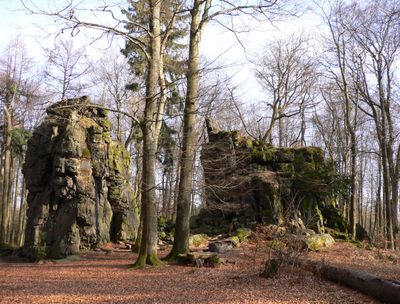
Wilhelmsteine is a rock formation made of iron ore boulders rising up to 15 meters high in the Schelderwald region, surrounded by beech forest. The rocks were shaped by natural geological forces and stand at about 585 meters elevation.
The rock group, formerly called Buchstein, was protected as a natural monument in 1952. It was renamed after Duke Wilhelm I of Nassau (1792–1839), who visited the rocks in 1830 and had a hunting lodge built there; after his early death in 1839 the name Wilhelmsteine replaced Buchstein.
The rocks were long called Buchstein before being renamed after Duke Wilhelm I of Nassau, who visited them in 1830; after his death in 1839 they took his name. Some regard the cluster as a pre-Christian cult site, and iron-age remains of a fortification lie nearby.
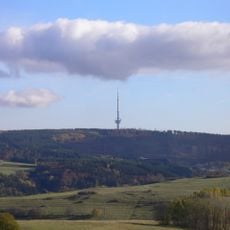
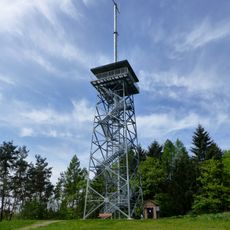
The rocks stand at about 585 m on the southeastern slopes of the Angelburg, roughly 700 m south-southeast of the television tower near the summit. The boundary with Eschenburg runs about 100 m away along the former Herborner Hohe Straße, which crosses the Brabanter Straße and joins the Westfalenweg nearby. The slope drops steeply about 110 m southeast toward Wallenfels.
The site is part of the National Geopark Westerwald-Lahn-Taunus and displays iron-rich geological layers that reveal natural rock formation processes. Visitors can observe how minerals and rocks change shape over extended time periods.
The community of curious travelers
AroundUs brings together thousands of curated places, local tips, and hidden gems, enriched daily by 93,811 contributors worldwide.