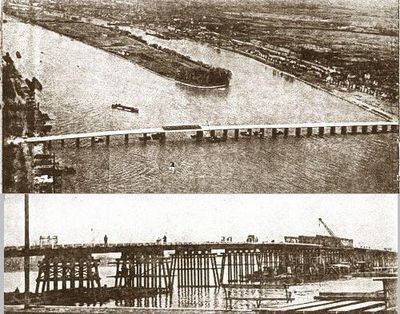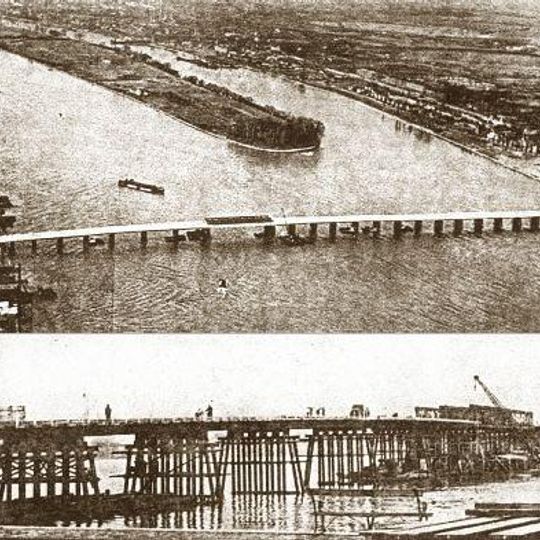
Alexander-M.-Patch-Bridge, Road bridge connecting Mainz and Wiesbaden, Germany.
The Alexander-M.-Patch-Bridge was a river crossing that spanned 610 meters across the Rhine, connecting Mainz and Wiesbaden. Its structure used 27 steel supports combined with wooden beams for the roadway, allowing traffic to flow in both directions.
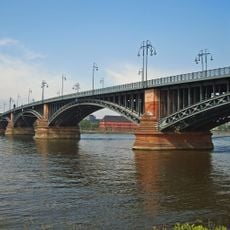
American forces built this crossing in 1946 after German troops had destroyed the previous bridge during the war. It served the region until 1950, when the Theodor-Heuss-Bridge opened and took over its role as the main connection.
The bridge is named after American General Alexander M. Patch, marking a moment of cooperation between American and German forces in the post-war era. It represents how both nations worked together to rebuild the region's connections.
This bridge was built to carry traffic on Federal Road 40 between Mainz and Mainz-Kastel and could support vehicles weighing up to 70 tons. Its design made it a working passage for goods and people moving between the two riverbanks.
Engineers from the American 333rd Engineer Special Service Regiment built this crossing using steel pipes for the main supports, which was a practical solution for post-war reconstruction. This engineering choice allowed them to complete a working bridge quickly with materials that were available at the time.
The community of curious travelers
AroundUs brings together thousands of curated places, local tips, and hidden gems, enriched daily by 91,221 contributors worldwide.