Welf family mausoleum, Royal mausoleum in Berggarten, Germany
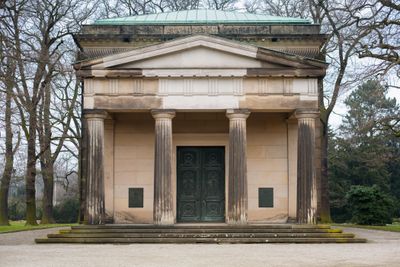
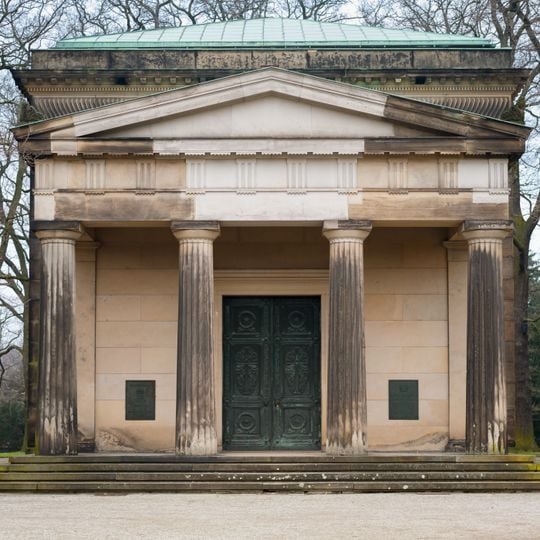
The Welf family mausoleum is a neoclassical burial chapel in the Berggarten at Herrenhausen. Its pale sandstone front has a triangular pediment on four tall fluted columns, with dark green double doors between them and two small plaques flanking the entrance. Laves had the barrel vault and dome built in wood and faced with white stucco marble to save time.
Queen Friederike of Hanover died on 29 June 1841, and two days later King Ernst August ordered court architect Georg Ludwig Friedrich Laves to design a mausoleum. Laves first proposed an Egyptian-style temple; building of a third, Doric design finally began in May 1842, and Laves worked on it until 1847. Sculptor Christian Daniel Rauch made Queen Friederike's sarcophagus between 1844 and 1847.
The name refers to the House of Welf, whose members are buried here. The U-shaped grove of 36 pedunculate oaks, transplanted in 1844/45 with 16 horses, frames the site; in spring Chionodoxa luciliae and dwarf narcissi bloom beneath the now over-200-year-old trees.
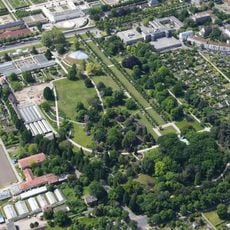
The mausoleum stands at the end of the linden avenue facing Herrenhausen Palace, reached on foot through the Berggarten; the entrance is up a short flight of wide stone steps, so the raised threshold and steps are the main obstacle for wheelchairs and pushchairs. The surrounding U-shaped grove of 36 transplanted pedunculate oaks shades the forecourt, where spring-flowering Chionodoxa luciliae and dwarf narcissi bloom beneath the crowns.
In 1844–45, 36 pedunculate oaks already about 60 years old were moved here on purpose-built wagons pulled by 16 horses; trees along the route were pruned and bridges reinforced. The U-shaped grove still surrounds the mausoleum, and in spring Chionodoxa luciliae and dwarf narcissi bloom beneath the crowns.
The community of curious travelers
AroundUs brings together thousands of curated places, local tips, and hidden gems, enriched daily by 94,369 contributors worldwide.