Außenalster, Artificial lake in central Hamburg, Germany
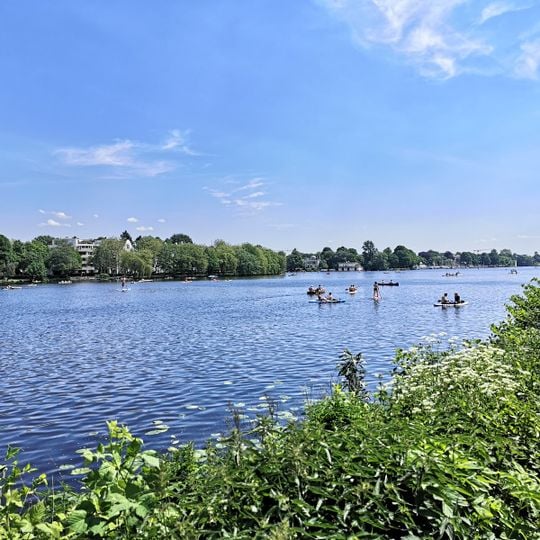
The Außenalster is an artificial lake covering about 164 hectares with an average depth of 2.5 meters in central Hamburg. It is bordered by parks, green spaces, and residential neighborhoods, forming a connected water system with the smaller Binnenalster.
The Alstersee was created in 1235 when Count Adolf IV of Schauenburg and Holstein dammed the Alster to power a grain mill; the dam became the Reesedamm, later widened into today's Jungfernstieg. Hamburg's ramparts of 1616–1625 divided the mill pond into Binnenalster and Außenalster, and a wooden bridge with a chained floating log controlled the outflow. The Lombardsbrücke was later built at that spot, and the Kennedybrücke followed in 1953.
The name Alster comes from an Indo-European root meaning "water" or "river"; it was recorded as Alstra around the end of the 11th century. Each May the Japanese community holds the Kirschblütenfest around the lake, with a large firework first set off in 1968 to mark the planting of some 5,000 cherry trees donated by Japanese firms based in Hamburg.
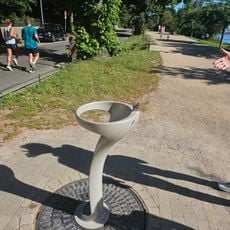
The 7.6-kilometre path around the lake is popular with joggers. Swimming is not recommended because of the density of watercraft and often shallow visibility. The lake is fed by the Alster, Osterbek and Wandse rivers and has several small bays.
The 7.6-kilometre path around the lake is popular with joggers. The lake is fed by the Alster, Osterbek and Wandse rivers and is on average only 2.5 metres deep. Swimming is not recommended because of the density of watercraft and often shallow visibility.
The community of curious travelers
AroundUs brings together thousands of curated places, local tips, and hidden gems, enriched daily by 92,783 contributors worldwide.