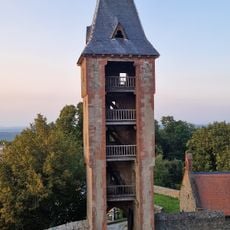
Alte Burg, Former castle site in Mühltal, Germany
Alte Burg is a completely vanished early medieval spur castle on the Altenburgkopf (266 m), a spur on the east side of the Schloßberg below Burg Frankenstein, about 250 m west-northwest of Nieder-Beerbach's village church. No remains have been found; only foundation traces were uncovered, suggesting a wooden castle, and the site had room for no more than a residential tower. The path circling the spur is thought to be the former moat, still mentioned in the 19th century.
Alte Burg was probably built in the mid-11th century on the Altenburgkopf spur, about 250 m west-northwest of Nieder-Beerbach's church. Its small plateau could hold little more than a residential tower, and since only foundation traces were found, a wooden structure is assumed. If it was an outer bailey of Burg Frankenstein, it was abandoned in the 13th century, when the new main castle was built on the summit. No documents record its owners or appearance.
The vanished castle survives in the local dialect as "Die áld Bejje", the old field name for the spur. Legend holds that underground passages linked the site with Burg Frankenstein, the Nieder-Beerbach church and the former Martinskapelle in Bessungen, hiding a treasure of gold, silver and wine. Treasure hunters dug here at Pentecost 1763, in 1770/71 and in 1787, until a tunnel collapse killed a man.
No ruins or walls are visible at the site; the castle has completely disappeared, so look for the terrain rather than masonry. The spot lies on the Altenburgkopf spur (266 m), about 250 m west-northwest of Nieder-Beerbach's village church, on the east side of the Schloßberg below Burg Frankenstein. The path circling the spur is considered the former castle moat, still mentioned in the 19th century.
Local lore holds that tunnels linked the vanished castle to Burg Frankenstein, the church of Nieder-Beerbach and the former Martinskapelle in Bessungen, hiding a hoard of gold, silver and wine. Treasure hunters dug on the spur at Pentecost 1763 with alleged permission of Ludwig VIII of Hesse-Darmstadt; the search stopped only when a man died in a collapsing tunnel. Attempts in 1770/71 and 1787 also failed, yielding only wall fragments toward the church and a spring.
The community of curious travelers
AroundUs brings together thousands of curated places, local tips, and hidden gems, enriched daily by 93,634 contributors worldwide.