Frankenstein Castle, Castle in Mühltal, Germany
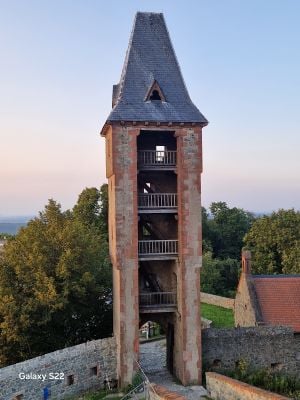
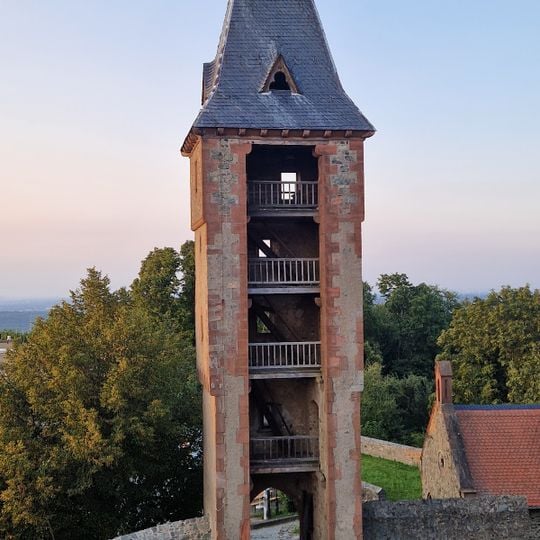
Frankenstein Castle is a ruined hilltop castle on a 370-metre spur of the Langenberg in the Odenwald, southeast of Darmstadt's Eberstadt district and above the Mühltal village of Nieder-Beerbach. Its core is divided into a main castle and an outer bailey enlarged around 1400; the two towers visible today date from a mid-19th-century restoration.
Lord Conrad II Reiz of Breuberg built the fortress before 1250 as the seat of an imperial barony under direct rule of the emperor. In the 17th century, the alchemist Johann Konrad Dippel used the site for his experiments, which may have inspired Mary Shelley's novel.
The name Frankenstein combines "Franks", the Germanic tribe that ruled this region, and "stein", old German for rock, referring to the crag the castle stands on. Local legend tells of Lord George, who slew a dragon plaguing Nieder-Beerbach and died from its poisonous spine; his tomb is in the village church. Since 1952, when AFN reporters broadcast a Halloween prank from the crypt, the castle has hosted one of Europe's largest Halloween festivals.
The site opens from sunrise to sunset and can be explored on foot, with sturdy shoes recommended for the stone pathways. A restaurant with an observation deck offers a chance to rest while overlooking the forested hills of the region.
On Halloween night in 1952, John Keel of the American Forces Network sent three reporters to the castle for a live broadcast, telling them a local legend held that the monster would return that night. Reporter Carl Nelson entered the crypt, where Keel had rigged a statue to move and topple as a prank; frightened listeners flooded the station with calls and military police were sent to the castle.
The community of curious travelers
AroundUs brings together thousands of curated places, local tips, and hidden gems, enriched daily by 93,135 contributors worldwide.