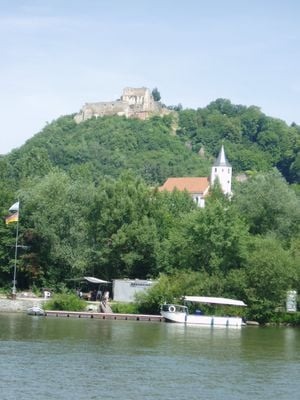
Donaustauf Castle, Medieval castle ruins in Donaustauf, Germany
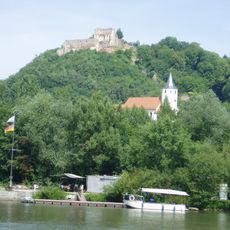
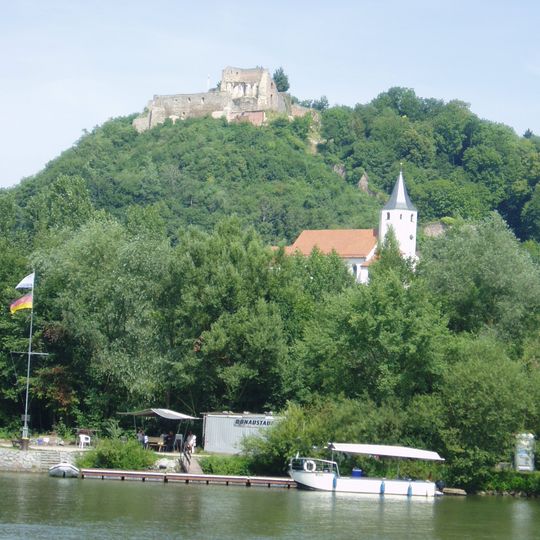
Donaustauf Castle is a castle ruin set on a rocky hill above the village of Donaustauf in Bavaria, on the south bank of the Danube. Sections of wall and foundations from different building phases are still standing, giving a clear sense of how the structure once spread across the hilltop.
The fortification was established in the early 10th century as a defensive position against raids into the region, and it was rebuilt and expanded several times over the following centuries. Excavations carried out in 1981 uncovered traces of a Celtic fort beneath the medieval layers, showing the hill was already used as a defended point around 500 BC.
The name stouf, Old High German for a cone-shaped rock or hilltop, was recorded as castellum quod dicitur Stufo between 894 and 930; the village of Donaustauf grew up later under the castle's protection, not the reverse. The ruin is one of over 40 castles in the Regensburg Land linked by footpaths known as Castle Trails; the Donaustauf Castle Trail runs about 30 kilometres.
The ruin is reached by a footpath from the village below, and the climb takes only a few minutes, though some sections are steep and the ground is uneven. Sturdy shoes are a good idea, and the views over the Danube are best enjoyed on a clear day when the light is good.
The name stouf is Old High German for a cone-shaped rock or hilltop, recorded as castellum quod dicitur Stufo between 894 and 930; the village took its name from this rock, not from the castle. The eastern round tower stump below the palas measures 15 m across with walls 5 m thick, added later to guard the open side toward the outer bailey plateau.
The community of curious travelers
AroundUs brings together thousands of curated places, local tips, and hidden gems, enriched daily by 92,843 contributors worldwide.