Walhalla memorial, Hall of fame memorial in Donaustauf, Germany.
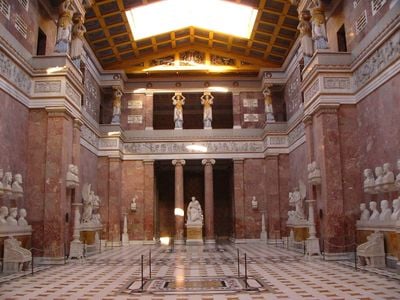
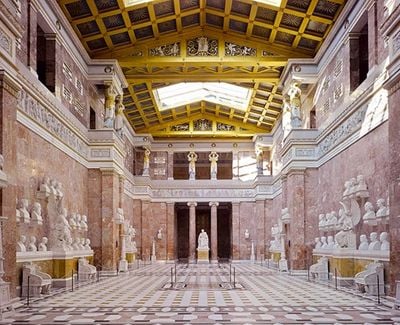
Walhalla is a Doric peripteros of Kelheim limestone on a stepped substructure above the Danube near Donaustauf, 66.7 m long and 31.6 m wide. Its north pediment shows Arminius at the Teutoburg Forest, the south Germania and the German states; inside, 132 busts and 64 plaques line walls of reddish-pink marble.
Ludwig I of Bavaria began construction in 1830, and the building was completed in 1842. The project was modeled on Greek temples and intended to strengthen awareness of shared language and culture across German-speaking territories.
The hall holds 132 busts and 65 plaques honouring figures of German tongue, among them only 13 women. Since 1962 new busts have been added every five to seven years, chosen by the Bavarian Council of Ministers on the recommendation of the Bavarian Academy of Sciences. Twelve marble armchairs by Ernst Mayer and eight marble candlesticks stand in the hall.
The monument opens daily from April to October, with shorter hours and a midday break during winter months. The climb to the entrance involves a broad flight of steps that may be tiring for some visitors.
The roof structure uses iron beams, an unusual technique at the time it was built. This solution allowed architects to combine the classical appearance of the temple with modern engineering methods.
The community of curious travelers
AroundUs brings together thousands of curated places, local tips, and hidden gems, enriched daily by 93,906 contributors worldwide.