Burg Laufenburg, Medieval castle in Laufenburg, Germany
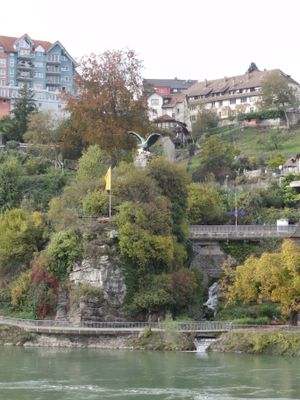
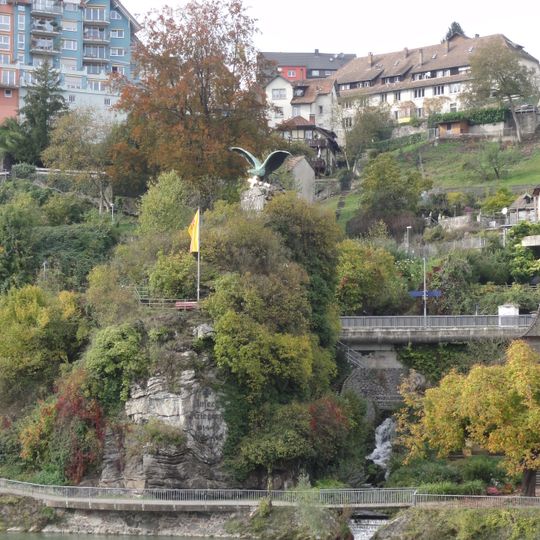
Burg Laufenburg, also called Burg Ofteringen, was a hill castle on a small gneiss rock on the right bank of the Rhine above the former Kleinen Laufen, opposite Laufenburg station. It was demolished around 1800; the site now holds the Kriegerdenkmal, a war memorial with a monumental bronze eagle on the Kriegerfelsen, formerly Oftringerfels.
Burg Laufenburg was probably built in the mid-11th century by the Lords of Lenzburg and is first documented in 1173. In 1207 the abbess of the Säckingen convent enfeoffed Rudolf II of Habsburg with it for ten pounds of wax a year. Later held by the Lords of Ofteringen, it passed in 1428 to Heinrich von Erzingen and in 1567 to Friedrich Schimpf. Already uninhabited by 1558, its last ruins were removed around 1800.
The name Laufenburg refers to the Kleines Laufen rapids, the rock ledge by the Rhine that gave the castle its name. The site is now called Kriegerfelsen after the war memorial with its bronze eagle placed there. The Schimpfhalde slope above is named after Friedrich Schimpf, who bought the castle in 1567.
The castle no longer stands: its site is the Kriegerfelsen, a gneiss outcrop on the right bank of the Rhine opposite Laufenburg station. Look for the war memorial with its bronze eagle, and nearby the portal of the Rappensteintunnel on the Hochrheinbahn line. The spot is reached on foot; the opposite bank holds the separate Habsburg-Laufenburg castle.
The castle site is now marked by a war memorial with a monumental bronze eagle on the Kriegerfelsen, a gneiss rock once called Oftringerfels. Nearby stands the portal of the Rappensteintunnel on the Hochrheinbahn, designed by Johann Belzer. The castle itself was demolished around 1800, so no walls remain.
The community of curious travelers
AroundUs brings together thousands of curated places, local tips, and hidden gems, enriched daily by 93,079 contributors worldwide.